TRILLIANT HEALTH RESEARCH
Studies
Timely trend analysis. Free in your inbox.
Receive weekly studies from Trilliant Health.
October 15, 2026
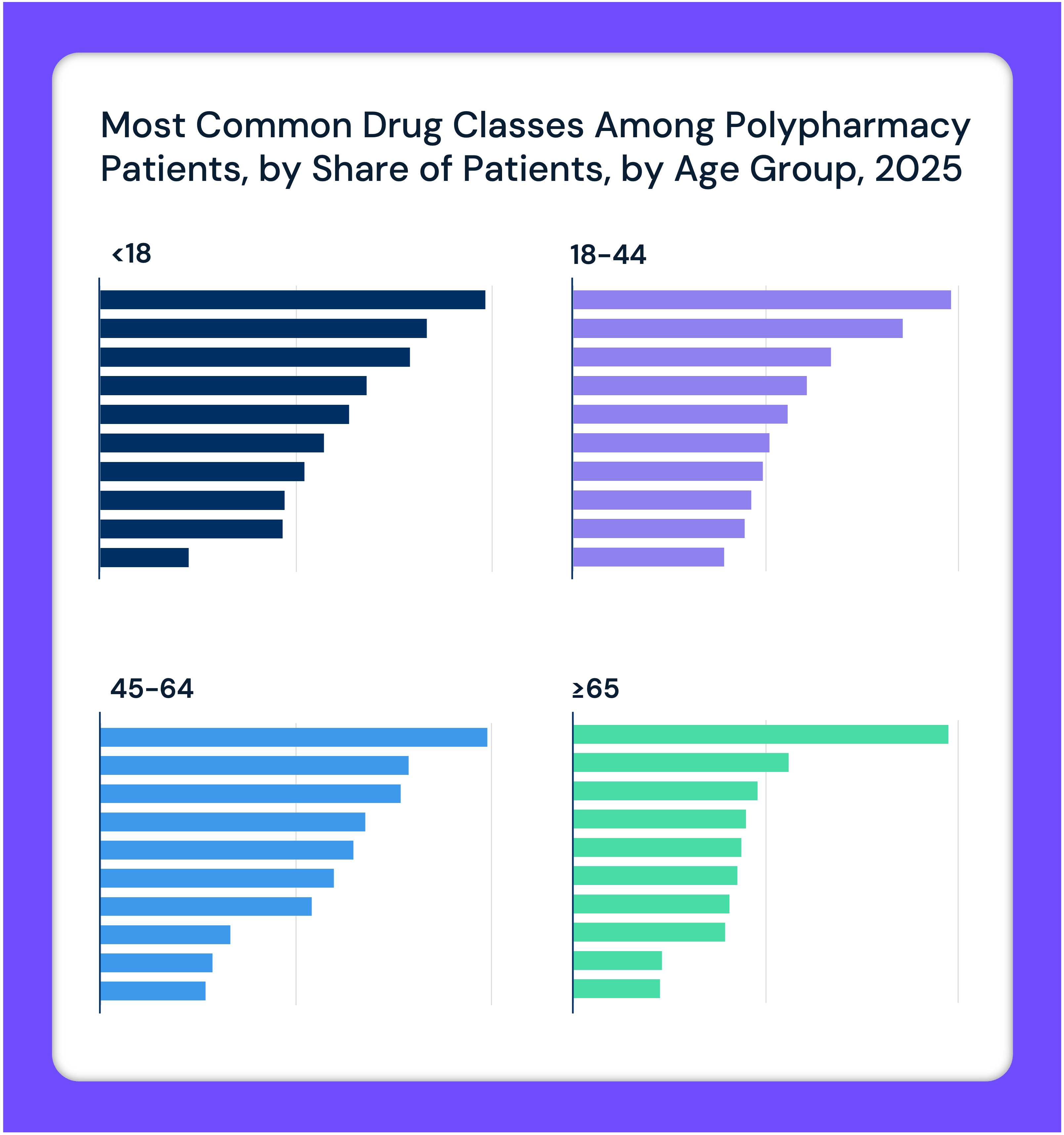
Polypharmacy Rates Continue to Rise Across All Age Groups
In 2025, 32.9% of patients with a prescription used five or more medications, up from 29.4% in 2019. Rates were highest for adults 65+ (58.4%) and higher for women than men in every age group.
Katie Patton • Austin Miller • Allison Oakes, Ph.D.
StudiesOctober 01, 2026
Projected Healthcare Demand Growth Is Slowing as the Population Ages
Across every care setting and clinical category analyzed, projected healthcare demand growth from 2026 to 2036 falls below historical rates, and many services are projected to see relatively flat demand.
Katie Patton • Austin Miller • Allison Oakes, Ph.D.
StudiesSeptember 24, 2026
Urgent Care Utilization Is an Inconsistent Predictor of Downstream Health System Loyalty
While patient loyalty to a health system urgent care was high (73.6% to 93.3%), loyalty to emergency, inpatient and primary care was varied. Urgent care loyalty is not as strong of a loyalty predictor as primary care.
Katie Patton • Allison Roberts, Ph.D. • Allison Oakes, Ph.D.
StudiesSeptember 10, 2026
Liver Disease Utilization and Mortality Increased Among U.S. Adults, Even as Alcohol Misuse Screening Decreased
Between 2019 and 2025, chronic liver disease mortality increased 12.1% and liver disease patient volume increased by 48.3% – increasing fastest among women, but higher among men. In contrast, alcohol misuse screening has decreased by 21.0%.
Katie Patton • Austin Miller • Clara Petrucelli • Allison Oakes, Ph.D.
StudiesSeptember 03, 2026
By January 1, 2028, Nearly Every Hospital Will Be Subject to Episode-Based Risk for Lower-Extremity Joint Replacement
CMS’s finalized CJR-X rule makes nearly every U.S. hospital financially responsible for 90 days of joint replacement costs, starting January 1, 2028, extending mandatory bundled payment nationwide.
Katie Patton • Allison Oakes, Ph.D.
StudiesAugust 27, 2026
The Majority of U.S. Physicians Are Employed, and Their Commercial Negotiated Rates Exceed Those of Independent Physicians
In the U.S., 59.4% of physicians are hospital-employed, varying widely by state and specialty. Employed physicians’ Chicago commercial E/M rates average $92 more than independent peers.
Katie Patton • David Taylor • Jim Browne • Maura Eshleman • Allison Oakes, Ph.D.
StudiesAugust 20, 2026
Healthcare Is Local, and So Is Physician Supply – Characteristics of Physicians at the National, State and Local Level and by Specialty
The U.S. primary care and specialist supply are evenly split, but an aging cardiologist shortage – especially in rural countries – threatens future care access.
Katie Patton • Allison Oakes, Ph.D.
StudiesAugust 13, 2026
Biopharmaceutical Research and Development Is Increasingly Focused on Complex, High-Cost Oncology Treatments
Biopharma R&D is shifting toward complex, costly oncology modalities – CGTs, ADCs and bispecifics. On-market CGTs average $563,313/course, yet pricing often shows no clear link to survival or QALY benefit.
Katie Patton • Allison Oakes, Ph.D.
StudiesAugust 06, 2026
Medicare Drug Spending Is Increasing While Service-Based Utilization Holds Flat, As the Medicare Trust Fund Nears Insolvency
Traditional Medicare per-beneficiary utilization is flat to declining, but Part B drug spending grew 7.8% annually between 2015 and 2023, driving cost growth and Trust Fund insolvency risk.
Katie Patton • Allison Oakes, Ph.D.
Interested in citing our research? Please follow this guide.