Study Takeaways
- The finalized FY2027 IPPS rule includes the most consequential change to joint replacement reimbursement since prospective payment began in 1983, the nationwide expansion of Comprehensive Care for Joint Replacement (CJR) Model known as CJR-X.
- CJR-X will take effect January 1, 2028, and will be mandatory for all hospitals not already mandated to participate in CMS’s Transforming Episode Accountability Model (TEAM), which took effect on January 1, 2026, for more than 700 hospitals in 186 CBSAs. CJR-X and TEAM imposed episode-based payment for both surgical and post-acute services provided to Traditional Medicare beneficiaries.
On July 31, 2026, the Centers for Medicare & Medicaid Services (CMS) finalized the fiscal year (FY) 2027 Inpatient Prospective Payment System (IPPS) and Long-Term Care Hospital (LTCH) rule (the 2027 Final Rule).1 In addition to the annual update to Traditional Medicare inpatient payment rates, the 2027 Final Rule includes the nationwide expansion of the CJR model – CJR-X – the most consequential financial provision for hospitals.
Together with the Transforming Episode Accountability Model (TEAM), which began on January 1, 2026, CJR-X will make episode-based payment the near-universal reimbursement arrangement for hospital-based lower-extremity joint replacement (LEJR) under Traditional Medicare, a change in the underlying payment architecture with no precedent in the last 40 years.
Background
Since the introduction of Diagnosis Related Groups (DRGs) in 1983, Medicare hospital reimbursement has been prospective, meaning a fixed payment per discharge intended to cover all costs incurred from admission through discharge. Under prospective payment, hospitals generate margin by delivering the services included in an inpatient stay at a cost below the applicable DRG rate, but they bear no financial accountability for costs incurred after the patient is discharged. Post-acute care providers are reimbursed under separate FFS (fee-for-service) systems, and in the absence of prospective payment for post-acute care, post-discharge utilization following LEJR has remained highly variable across skilled nursing facilities, home health agencies, inpatient rehabilitation facilities and outpatient therapy.
Beginning in 2012, CMS, through its Center for Medicare and Medicaid Innovation (CMMI), sought to address that variation through voluntary bundled payment models. These bundled-payment demonstrations included Bundled Payments for Care Improvement (BPCI) and CJR, which operated from April 2013 through September 2018 and April 2016 through December 2024, respectively. However, voluntary participation tends to attract providers already positioned to perform well under a model's financial terms, which limits the extent to which reported savings reflect behavioral change rather than favorable selection. Net savings generated by CMMI models have been modest relative to total Medicare spending and have not produced a measurable reduction in Medicare's aggregate spending trajectory.2 The finalized CJR-X model, together with TEAM, expands this policy trajectory by changing model participation from voluntary to mandatory.
TEAM took effect on January 1, 2026, requiring more than 700 hospitals to accept financial accountability for care delivered across the index hospitalization and 30 days post-discharge for five surgical episode categories, including LEJR.3 The finalized FY2027 rule refines TEAM by expanding the set of eligible spinal fusion episodes, to better align episode attribution and quality measures with other CMS programs and models and to refine the pricing methodologies used to construct target prices.
CJR-X will be mandatory on January 1, 2028, for every acute care hospital paid under the IPPS, other than hospitals already participating in TEAM and hospitals located in Maryland. CJR-X differs from the original voluntary model by 1) adding ankle replacement to the hip and knee procedures covered by CJR, 2) applying to procedures performed in both inpatient and hospital outpatient settings rather than inpatient-only, the focus of the original model and 3) operating nationwide rather than in select metropolitan areas.
Under CJR-X, individual providers and suppliers will continue to be paid under existing Medicare payment systems, with a “true-up” following the performance year:
“All providers and suppliers furnishing LEJR care to patients would continue to be paid under existing Medicare payment systems. Following the end of a model performance year, actual total spending for the episode would be compared to the participant hospital’s target price and, depending on quality and spending performance, the hospital could receive an additional payment from Medicare or be required to repay a portion of the episode spending.”4
Once effective, CJR-X and TEAM together will establish episode-based payment with downside risk as the reimbursement structure for hospital-based LEJR for essentially all Traditional Medicare beneficiaries.
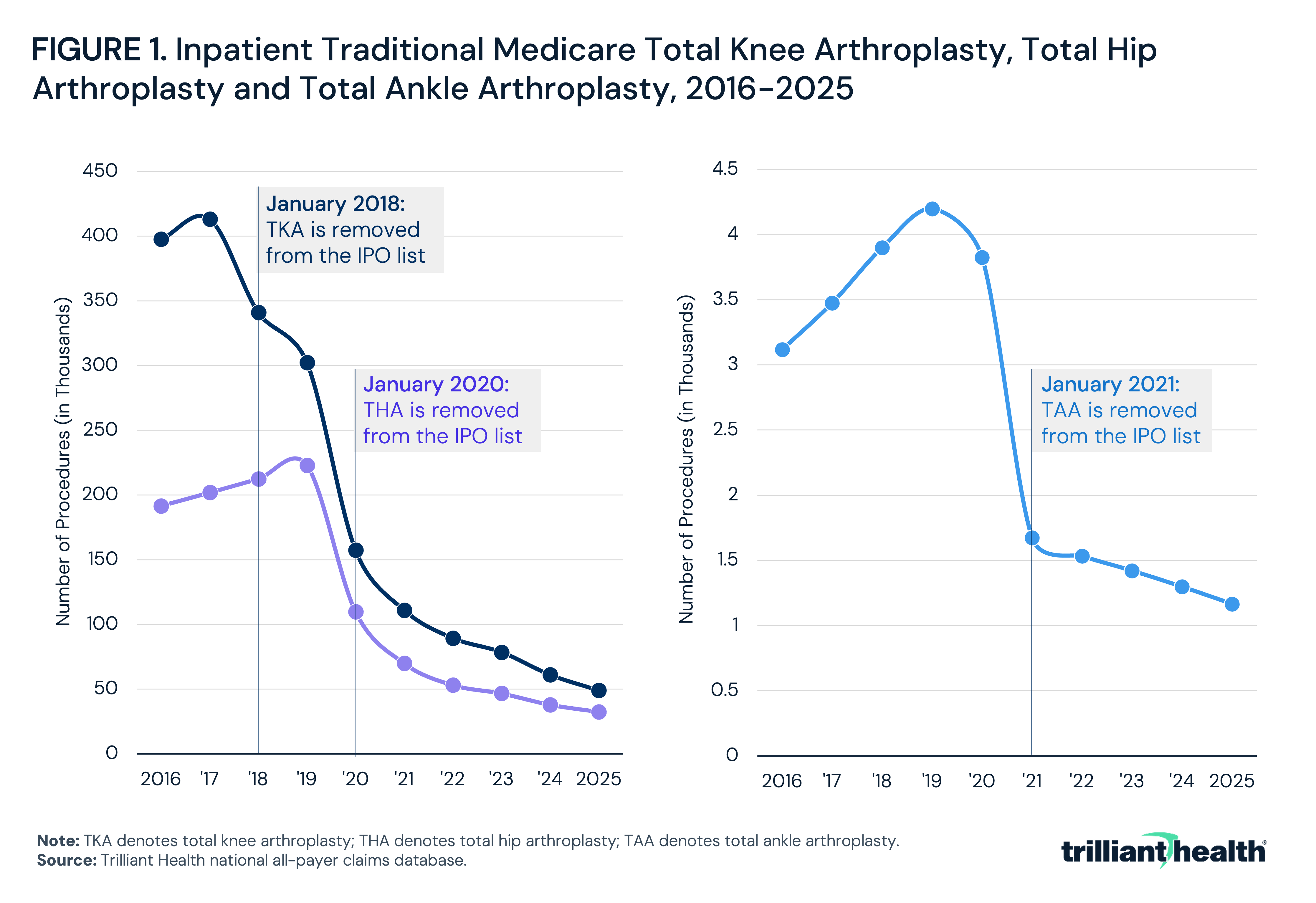
Total knee arthroplasty (TKA), total hip arthroplasty (THA) and total ankle arthroplasty (TAA) were removed from the Inpatient-Only (IPO) list in 2018, 2020 and 2021, respectively, the catalyst for a substantial shift of those procedures to outpatient settings among Traditional Medicare beneficiaries. Because both TEAM and CJR-X apply to inpatient and hospital outpatient episodes, the models implicitly accommodate continued migration of LEJR to lower-acuity settings, while procedures that migrate to ambulatory surgery centers (ASCs) remain outside the scope of both mandatory models for now.
Given the context of CJR-X and TEAM, this study characterizes the exposure of hospitals and downstream health economy stakeholders to mandatory bundled payment for LEJR.
Analytic Approach
National all-payer claims were used to analyze Traditional Medicare and Medicare Advantage (MA) inpatient TKA, THA and TAA volume from 2016 through 2025.
To examine TEAM and CJR-X episode cost, this analysis used 2024 CMS Limited Data Set (LDS) claims covering Traditional Medicare LEJR episodes for every hospital performing LEJR, whether currently participating in TEAM or included in the CJR-X model. LEJR episodes were identified using MS-DRGs 469, 470, 521 and 522 for inpatient procedures and CPT codes 27130, 27447 and 27702 for hospital outpatient procedures. For each hospital in TEAM, 30-day episode costs were calculated following inpatient discharge or the date of an outpatient procedure. For each hospital in the CJR-X model, 90-day episode costs were calculated following inpatient discharge or the date of an outpatient procedure. Episode costs include spending across inpatient, hospital outpatient, long-term acute care (LTAC), skilled nursing facility (SNF), home health, hospice and emergency department (ED) settings during the 30- or 90-day window. Ambulatory care, anesthesia, professional fees and durable medical equipment (DME) are not included, so actual total episode costs are higher than those reported here.
Findings
After TKAs were removed from the IPO list in 2018, inpatient volume declined by 17.5% from 2017 to 2018 (Figure 1), with 2025 inpatient TKA volume 88.2% lower than 2017 volume. Similarly, inpatient volume for THAs declined 50.8% from 2019 to 2020 after it was removed from the IPO list, with 2025 inpatient THA volume 85.5% lower than 2019 volume. Inpatient TAA volume declined 56.2% from 2020 to 2021 after it was removed from the IPO list, with 2025 inpatient TAA volume 69.5% lower than 2020 volume.
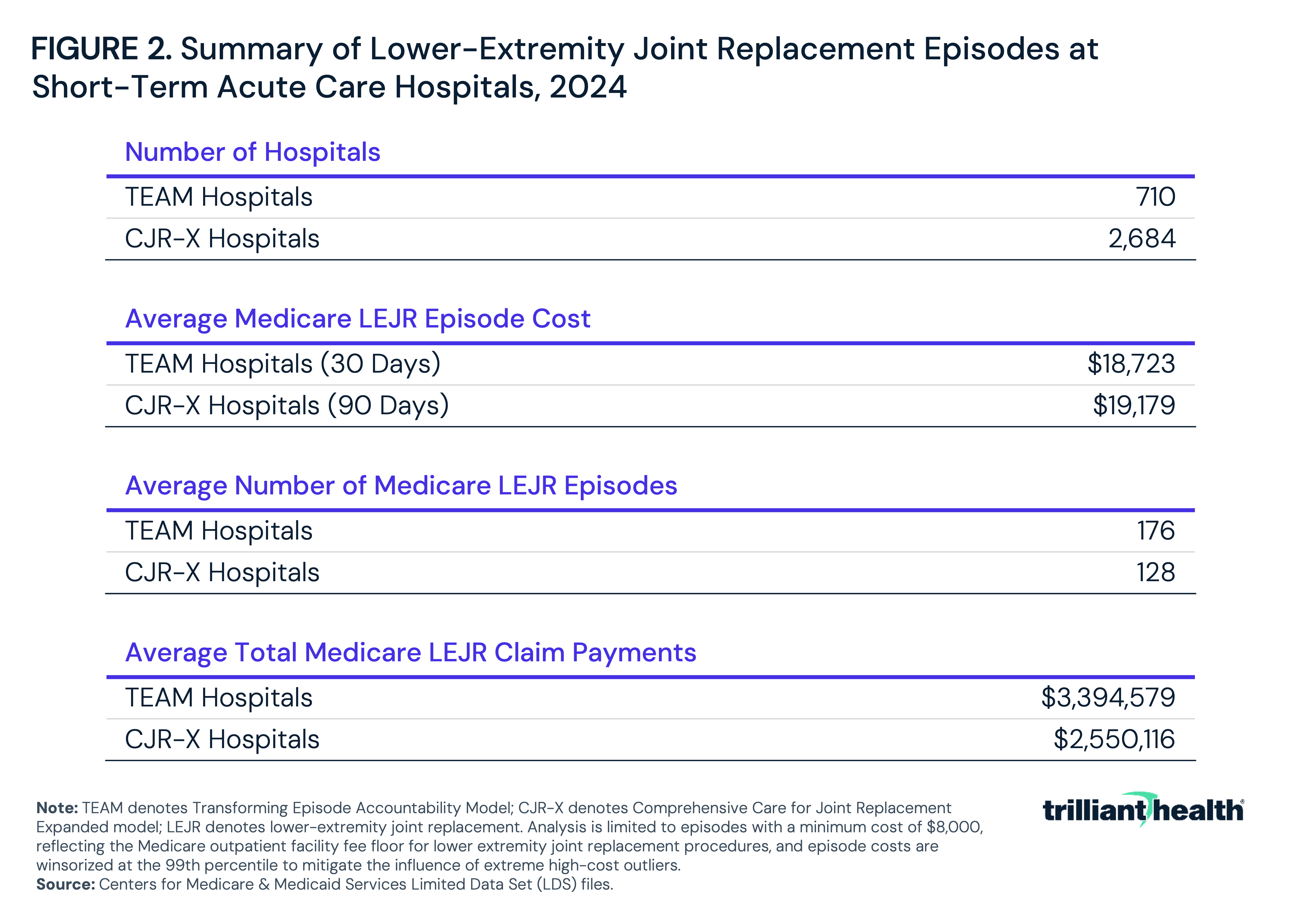
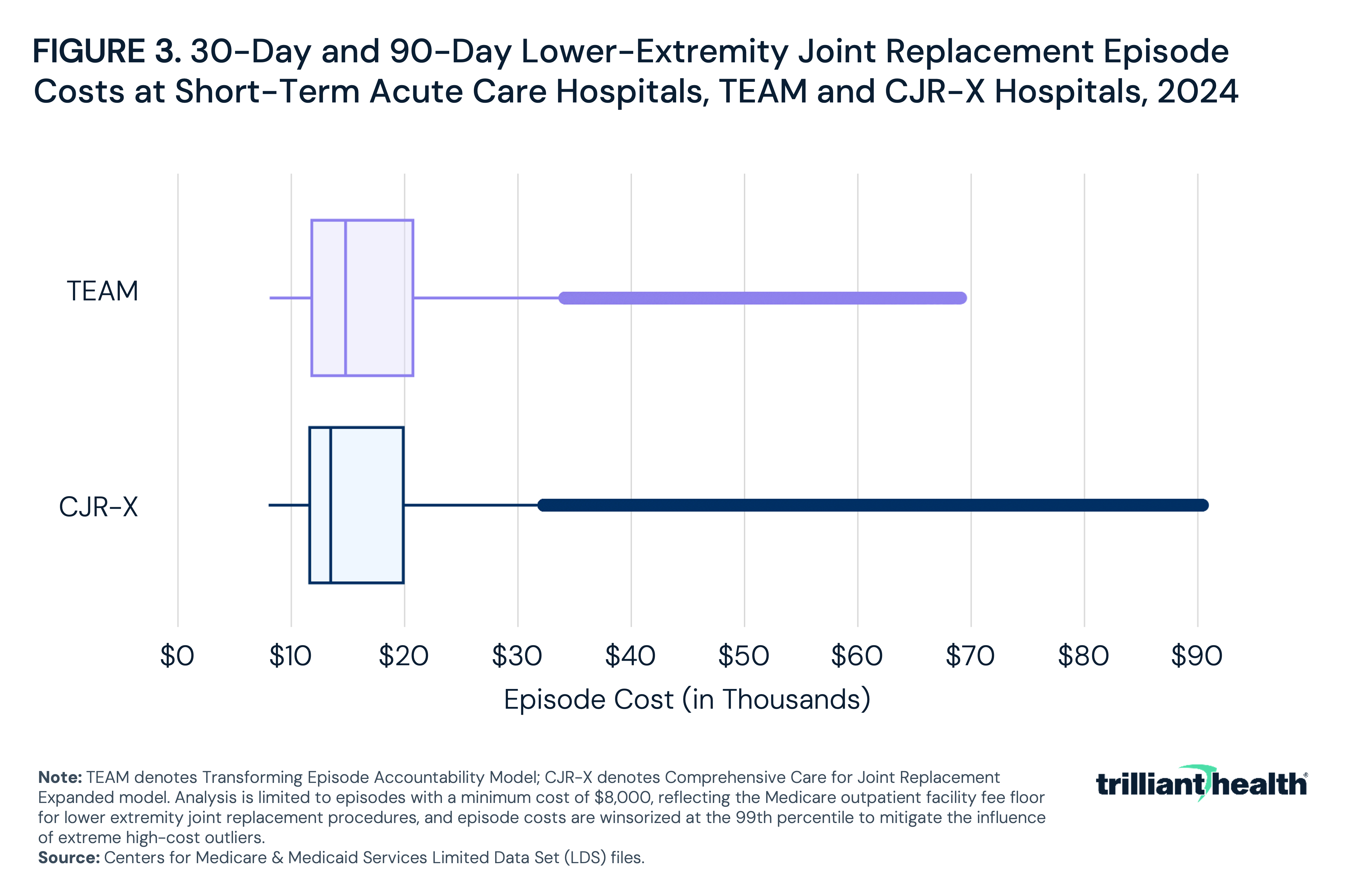
In 2024, TEAM hospitals had a greater average number of Medicare LEJR episodes than CJR-X hospitals (176 compared to 128) and, in turn, higher average total Medicare LEJR reimbursement ($3.4M for TEAM hospitals and $2.6M for CJR-X hospitals) (Figure 2). TEAM hospitals had average 30-day LEJR episode costs of $18,723, and CJR-X hospitals had average 90-day LEJR episode costs of $19,179. The range of episode costs for CJR-X is wider than TEAM hospitals (Figure 3).
Conclusion
The commencement of CJR-X on January 1, 2028, will be the most recent step in a decade-long process to reduce the cost of LEJR for Traditional Medicare beneficiaries. The prior elimination of TKA, THA and TAA from the IPO list removed the inpatient-only requirement, leaving site-of-service decisions for LEJR to clinical judgment, physician preference and patient choice. TEAM and CJR-X are a mandatory delegations of financial risk to hospitals for the cost of both inpatient and post-acute care for either 30 days (TEAM) or 90 days (CJR-X) post-discharge, regardless of whether the procedure is delivered in a hospital inpatient or outpatient department. In tandem, the combined effect of these policies may accelerate the shift of LEJR to lower-acuity settings while extending financial accountability across those settings.
Since the introduction of DRGs, hospitals have been responsible for the costs associated with a patient’s hospital stay. In 2024, the average length of stay for a THA was 1.1 days, down from 3 days in 2012.5 Except for hospitals that participated in CJR or BPCI, hospitals have never been required or incentivized to manage the financial cost of a patient’s post-discharge care. Under TEAM or CJR-X, CMS delegates to a hospital the financial risk for what happens for 30 or 90 days post-discharge, respectively, a time horizon that is 10-90x longer than before.
As such, TEAM and CJR-X implicitly acknowledge that the Federal government is unwilling – or unable – to address the wide variance in total cost and quality for the exact same service. The fact that the unit price for these Medicare procedures is effectively fixed evinces the extraordinary variation in post-acute sites of care and post-discharge utilization. Said differently, post-acute care is stochastic, and TEAM and CJR-X implicitly indict the entire post-acute industry for failing to provide value for money in their services, whether due to a lack of efficiency or quality or both.
As a result, the mandatory nature of TEAM and CJR-X requires a 180° change in the clinical, operational and financial approach for every hospital. Since the introduction of DRGs in 1983, hospital executives have focused exclusively on controlling the things that happen inside the hospital. Under TEAM and CJR-X, hospital executives must now extend their focus to events that occur in literally dozens of sites of care (e.g., inpatient rehabilitation, skilled nursing, physical therapy clinics, physician offices, imaging centers, home health) that are beyond their control. Notably, the most direct lever for managing that cost is constrained, because Medicare Conditions of Participation and the IMPACT Act of 2014 limit a hospital's ability to steer patients to its own post-acute facilities. Whether mandatory episode-based payment at national scale reduces the systemic cost of LEJR care depends on whether hospitals can manage episode spending without offsetting administrative cost, which the track record of CMMI model performance suggests is uncertain.
These policy changes compound rather than offset, and they fall hardest on the hospitals least able to participate in the care setting shift that is driving them. A hospital without an established outpatient and ASC presence risks losing the healthier, lower-cost cases and their revenue to competitors while remaining fully accountable under CJR-X and TEAM for the higher-cost cases that cannot safely move.
For LEJR specifically, procedures that migrate to ASCs remain outside both mandatory models for now, so the population subject to bundled payment is likely to become progressively higher-acuity as lower-complexity cases move to ASCs, which would place upward pressure on episode costs through patient mix rather than inefficiency. In effect, the shift concentrates the sickest and most complex patients in the hospital, and because those episode targets are calibrated on a historical case mix that included the lower-acuity cases now moving away, the retained population could exceed the target price for reasons unrelated to hospital performance. Whether CMS can distinguish those two sources of cost variation and adjust target prices accordingly will bear on the durability of both models' financial terms.
Of course, the impact of TEAM and CJR-X is not limited to hospitals. For device manufacturers and post-acute providers, mandatory episode accountability raises the premium on demonstrating measurable contributions to episode cost or quality.
The Emergency Medical Treatment and Labor Act (EMTALA) effectively makes the hospital the provider of last resort. TEAM and CJR-X are seemingly designed to make the hospital the insurer of last resort, at least for select high-volume, high-cost surgical cases. History suggests that commercial insurers will follow CMS in transferring post-acute cost risk to hospitals. Making hospitals the insurer of last resort may be the most radical change in healthcare policy since the creation of Medicare and Medicaid in 1965.
Get the latest insights delivered to your inbox.
Related Research
Was this shared with you?
Subscribe for weekly insights.
Subscribe to receive weekly insights from Trilliant Health's Research Team
Interested in citing our research? Please follow this guide.