Study Takeaways
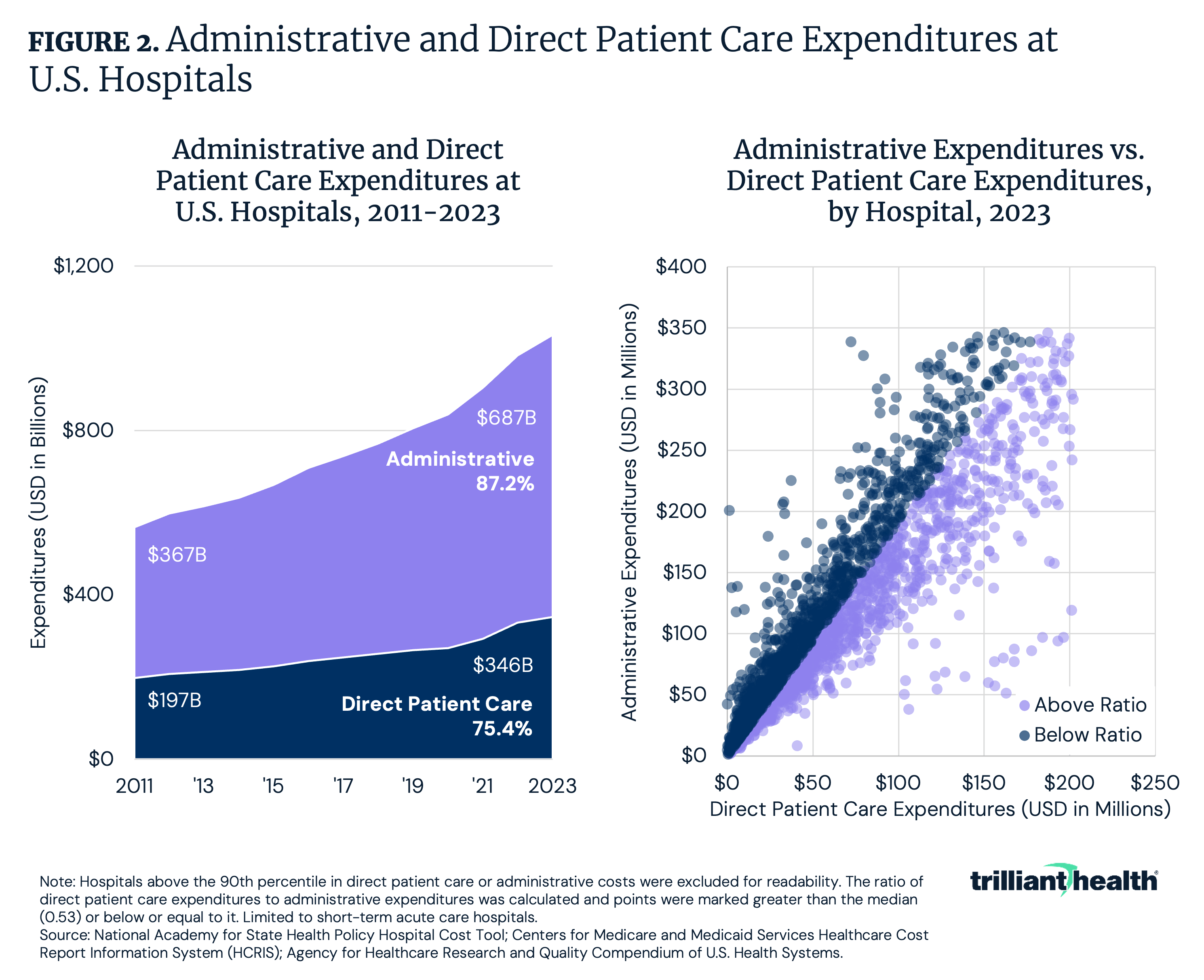
- In 2023, hospital administrative costs reached $687B compared to $346B in direct patient care, a ratio of approximately 2:1.
- Administrative expenditures at U.S. hospitals grew 87.2% from 2011 to 2023, outpacing direct patient care spending growth of 75.4%.
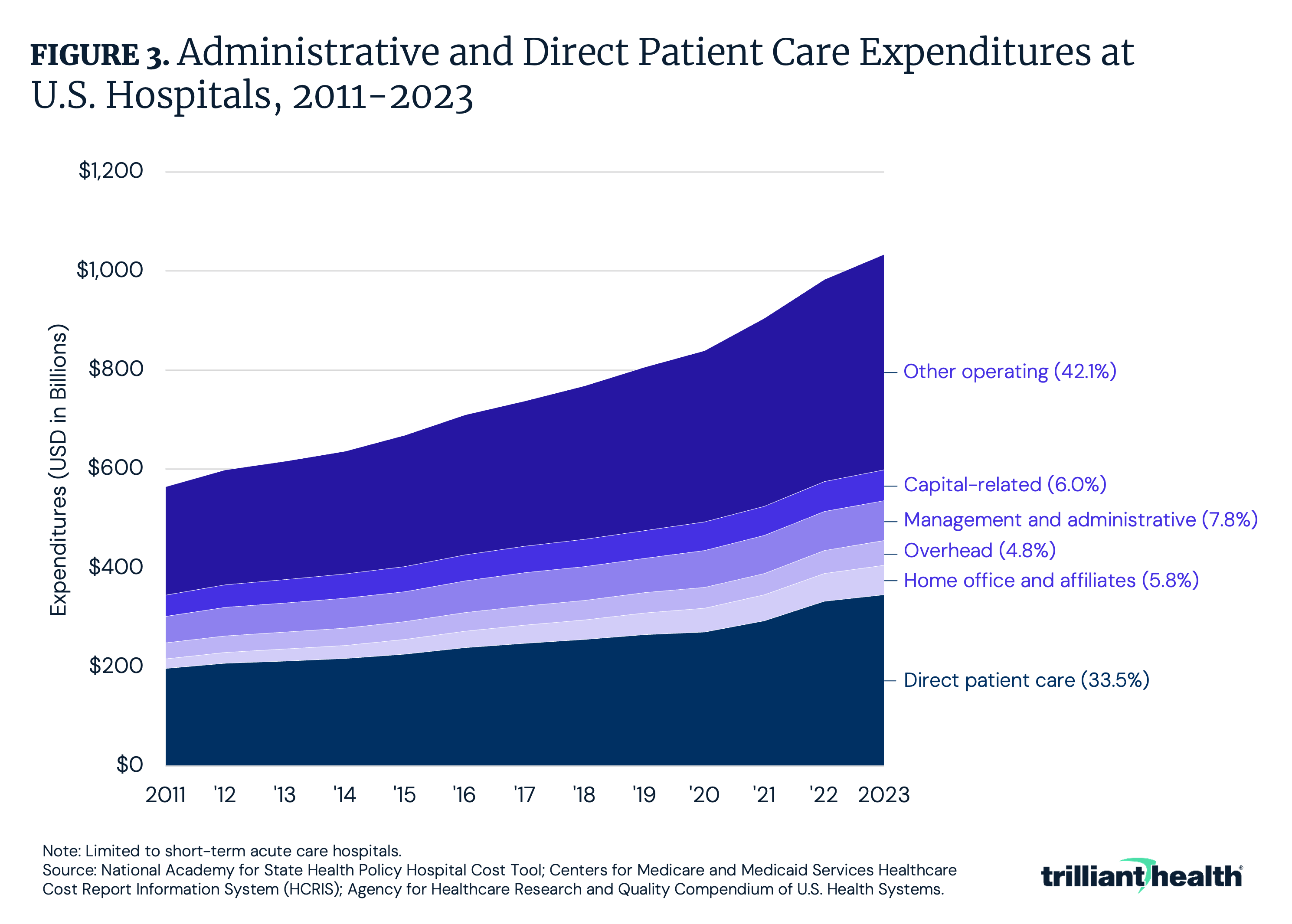
- Administrative costs as a share of total hospital operating expenditures increased from 65.0% to 66.5%, while direct patient care declined from 35.0% to 33.5%.
The U.S. healthcare system has long been criticized for its complexity. Using publicly reported data, this analysis examines the quantity and growth trajectory of hospital administrative and direct patient care spending.
Background
Healthcare administration is commonly cited as accounting for 20-30% of U.S. health expenditures, which totaled $4.9T in 2023.1 These cited figures stem from a 1991 New England Journal of Medicine study that benchmarked U.S. healthcare spending against Canada’s healthcare spending.2 This study concluded that the average U.S. hospital devoted 20.2% of its spending on administration. The researchers repeated the study in 2003, concluding the share of U.S. administrative spending had increased to 25.4%.3 These studies have often been used to support the adage that 30% of U.S. healthcare is wasteful, even though the fundamental differences between the U.S. multi-payer system and Canada's single-payer model limit direct comparisons and benchmarking between the two systems.
Over the last 30 years, several researchers have sought to define and quantify wasteful spending in U.S. healthcare, using a variety of data sources and benchmarks.4,5,6,7,8,9,10 Another commonly cited source on waste in healthcare is Don Berwick’s 2012 “Eliminating Waste in US Health Care” Health Affairs article, which estimated that six categories of waste accounted for 18% to 37% of healthcare spending.11,12
The act of quantifying administrative spending and ultimately waste is in many ways Sisyphean, as it can never be fully achieved without disagreement or dispute among healthcare stakeholders. However, one indisputable source of truth for healthcare spending is the Centers for Medicare and Medicaid Services (CMS) Healthcare Cost Report Information System (HCRIS), which includes hospital-reported operational and financial data. Using HCRIS data, this study seeks to examine trends in hospital-reported expenditures attributed to direct patient care and administration.
Analytic Approach
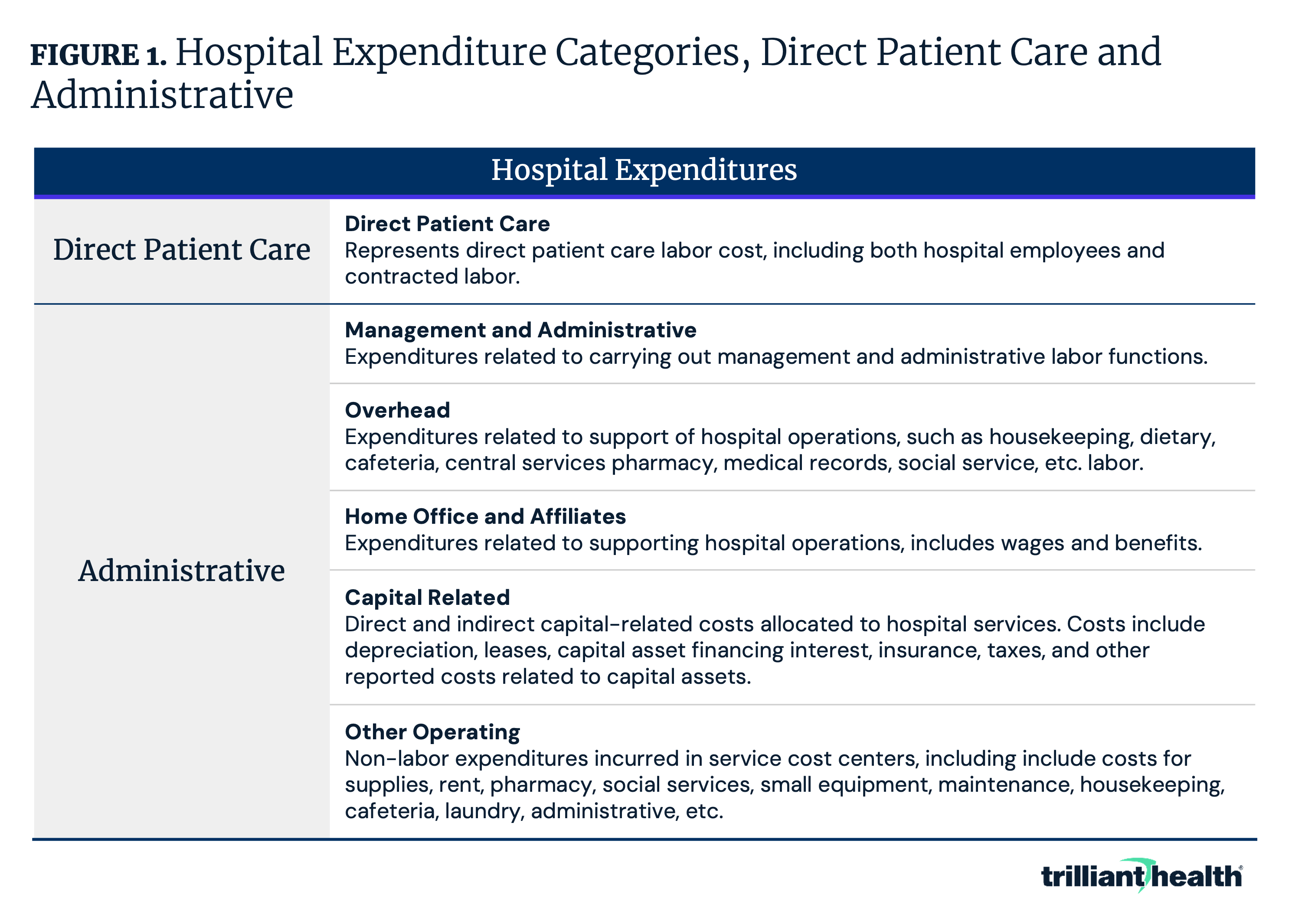
The CMS HCRIS and National Academy for State Health Policy Hospital Cost Tool were leveraged to examine hospital costs from 2011 to 2023. Expenditures were segmented into direct patient care and administrative categories (Figure 1).
Findings
From 2011 to 2023, both administrative and direct patient care expenditures increased in absolute terms, reaching $687B and $346B, respectively, or a ratio of approximately 2:1 (Figure 2). However, administrative costs grew at a faster pace (87.2%) than direct patient care spending (75.4%).
 Administrative costs (i.e., all non-direct patient care expenditures including home office and affiliates, overhead, management and administrative, capital-related and other operating) increased from $367B in 2011 to $687B in 2023 (Figure 3). Within administrative costs, home office and affiliate expenditures showed the fastest growth at 212.2%, increasing from $19.1B to $59.8B. Management and administrative expenditures grew 51.6%, from $53B to $81B. Overhead costs increased 53.3%, from $32B to $49B. Capital-related expenditures grew 43.9%, from $43B to $62B. Other operating expenditures, the largest administrative subcategory, grew 98.5%, from $219B to $435B. While direct patient care spending grew substantially in absolute terms, it grew slightly slower than total hospital expenditures over the time period. Administrative costs maintained their dominant share of hospital operating costs.
Conclusion
This analysis leverages HCRIS data, audited financial information that hospitals are required to submit to CMS and subject to enforcement under the Federal False Claims Act. While acknowledging that most health systems and hospitals have bespoke calculations of administrative expense, the operational reality is that for every dollar spent on direct patient care in 2023, U.S. hospitals spent nearly two dollars on administrative and operational costs.
These findings echo Peter Drucker's observations that “health care is the most difficult, chaotic and complex industry to manage today” and that hospitals are "the most complex human organization ever devised," characterized by high capital costs, high labor costs and substantial regulatory burden.13 While this analysis demonstrates only a portion of the operational cost structure in U.S. hospitals, it raises fundamental questions about the sustainability and efficiency of the current system.
Waste represents the most significant and obvious obstacle to achieving value for money in healthcare. Any activity in any enterprise that does not contribute to the primary mission creates inefficiency. While the complexity of hospital operations inevitably will generate administrative requirements, the rate at which these costs have outpaced direct patient care spending warrants further examination and reflection from hospital and health system operators. Moreover, regulators and payers should consider the extent to which any and every regulatory or administrative requirement delivers value for money to the health economy and, more importantly, the American consumer.
The U.S. health economy represents approximately 18% of U.S. GDP and on a standalone basis is larger than the entire GDP of every country except China and Germany. While the extent of waste in the U.S. health economy is subject to debate, the existence of it is not. Every health economy stakeholder – policymakers, regulators, employers, hospitals, health insurers and life sciences companies – has a strategic, financial, ethical and arguably moral obligation to eliminate waste from the system before it collapses under its own weight.
Get the latest insights delivered to your inbox.
Was this shared with you?
Subscribe for weekly insights.
Subscribe to receive weekly insights from Trilliant Health's Research Team
Interested in citing our research? Please follow this guide.