Counterpoint
Hal Andrews | March 4, 2026“I’m from the government, and I’m here to help.”
I recalled President Reagan’s description of the nine most terrifying words in the English language while listening to HHS Secretary Kennedy’s February 12 appearance on Theo Von’s podcast This Past Weekend:
Secretary Kennedy: The other thing that we’re doing is we’re doing price transparency so that every hospital will have to publish its prices for every procedure.
Theo Von: Power to the patients. Are you familiar with that?
Secretary Kennedy: Exactly. And that’s to make you the CEO of your own health.
Theo Von: They already are supposed to do that, right?
Secretary Kennedy: It was a law that Trump passed his first term but Biden never enforced it so none of the hospitals do it. We‘ve now passed new regulations that [will] punish them [in a] draconian way if they don’t do it so they’re all going to be doing it by the end of this year…
Right now, if you’re pregnant in this country you could go nine months on the phone every day trying to figure out what the childbirth [will] cost you in your local hospital and not be able to do it. And we are about to go online with a system that will make all procedures visible to every patient.
So, I actually looked at the mockup two days ago for New York, and it shows a map of Manhattan and a mile around Manhattan and there’s 30 hospitals, and it shows the price of childbirth at every hospital. The lowest one is $1,300, and the highest is $22,000, and it’s everything in between…$9,000, $5,000, $3,000.
Theo Von: You can look and see.
Secretary Kennedy: You can look and see.
Theo Von: You’ll be able to go to a menu online.
Secretary Kennedy: It’s like GasBuddy® when you’re looking for a gas station, you’re gonna be able to do that.
Theo Von: Yeah, a clean bathroom whatever, that clean bathroom, you ever use that one, that one’s crazy and they lie on there and some of them are at rest areas, too, and I got accosted by a guy who was like an Easter Bunny impersonator, anyway, whatever, good to be here today. So, you’re telling me that that’s gonna be a real thing, that’s gonna be available to us on our phones, so say, if you, if I need to get a MRI I can look online.
Secretary Kennedy: You can look and find and right now there’s no way you can figure out the cost of a MRI.
Theo Von: There’s not a chance, and they lie to you but if you call them and say, “OK, I’m not gonna come,” I’ve had experiences where they will call you back and then will offer you a lower price.
Secretary Kennedy: And then tell you, yes, but they’re all playing that game, and now they’re not going be able to do that anymore.
Theo Von: How soon is that gonna be released?
Secretary Kennedy: It’s gonna be released very, very soon in the next couple of months. All the hospitals now have to come online and start reporting. The ones that don’t do it immediately we are gonna have very, very high fines for them so there’s gonna be a big incentive for them to start reporting, but it’s also gonna drive down prices because why is there that observed differential between $1,300 and $22,000.
Theo Von: Because we don’t know.
Secretary Kennedy: Because we don’t know so there’s no market, so they do whatever the hell they want and now there’s gonna be competition because people are going to be able to shop.1
President Reagan’s remark is funny because it slyly admits that government is prone to make things worse, usually out of ignorance. Because several things are obviously wrong in the dialogue between Secretary Kennedy and Theo Von, it is easy – and perhaps your initial instinct – to throw the baby out with the bathwater.
You, of course, know that CMS’s Transparency in Coverage Final Rule isn’t a law but rather a regulation implemented based on an Executive Order. Similarly, you know that hospitals have been required to comply with price transparency since January 2021, and you know that some hospitals could not meet the technical requirements and that others steadfastly refused to comply… which is why the Trump Administration has ratcheted up the fines. Regular Counterpoint readers know that the price of an MRI in a hospital is easily accessible, since we published all hospital price transparency files for free and even included a chatbot to query it.
Unlike CMS, you might understand the quixotic nature of hospital price transparency for consumers, because you know that annual hospital admissions represented only 11% of all healthcare encounters in the U.S. in 2024 and that ~50% of all hospital admissions originate in the emergency department. You know that no one checks a price transparency application in the back of an ambulance, so ~$800B of hospital spending is invulnerable to patient shopping. Some of you might wonder whether CMS’s focus on OB services indicates a paucity of women of child-bearing age involved in CMS’s price transparency initiatives, because you know that – except in an emergency – expectant mothers always choose a hospital based on the admitting privileges of the OB, not the per diem rate.
On the other hand, few of you, including every price transparency vendor in the health economy, seem to understand the fundamental flaw in healthcare price transparency for consumers, which is the limited actionability of price transparency after the employer’s selection of a provider network and the employee’s selection of a benefit tier. While acknowledging Secretary Kennedy’s view that there are, in fact, a handful of hospitals that “do whatever the hell they want,” what is left unsaid is that those hospitals have established sufficient brand and/or clinical quality to be “price setters.”
However, at least 95% of hospitals are “price takers,” and the real randomness in healthcare costs is directly attributable to the difference in commercial rates that the same providers receive for performing the exact same service from different payers.
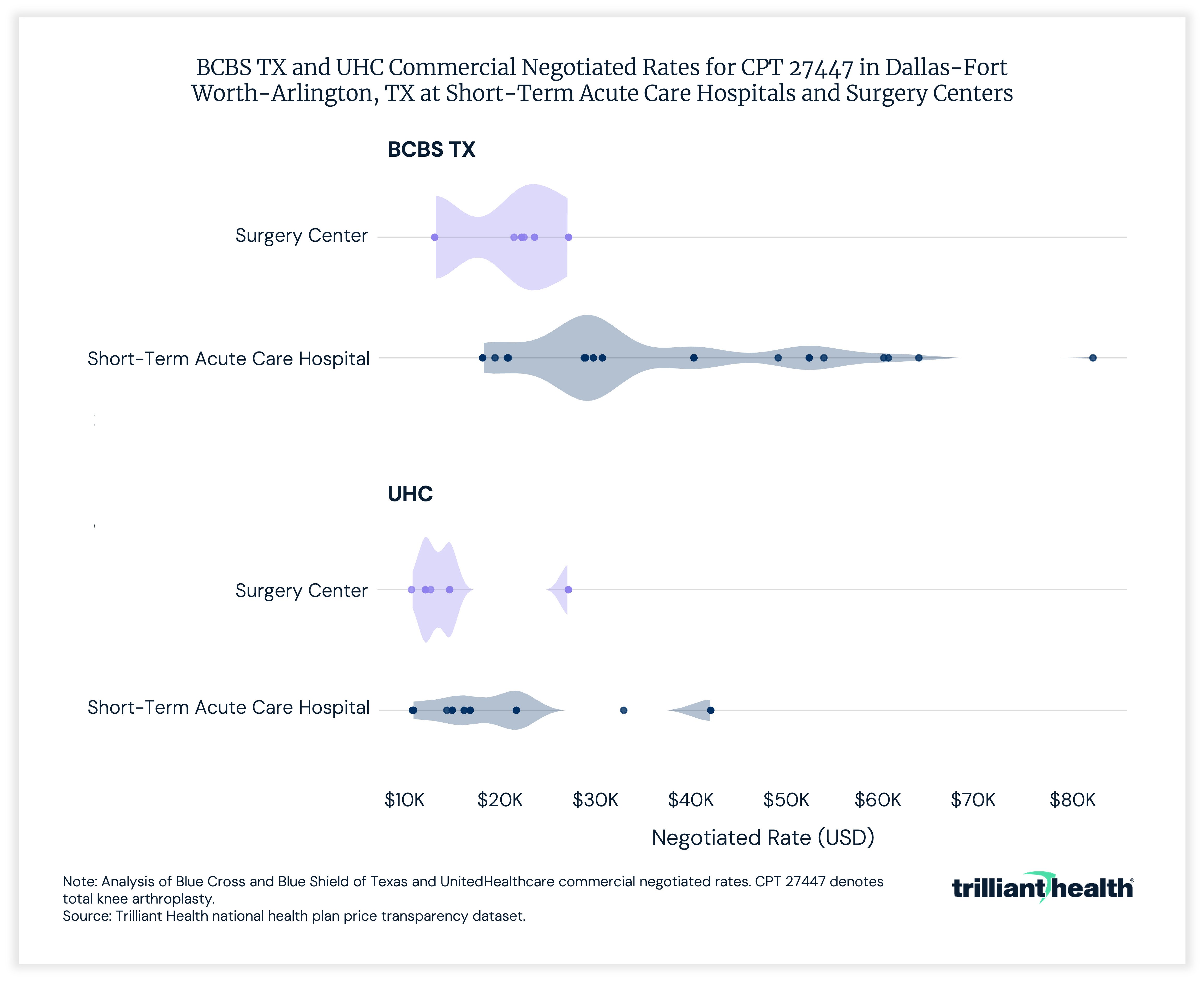
The fact that I have complete clarity that a bottled water at the airport costs me $6 after TSA screening is not indicative of what bottled water costs in a free market. By definition, a provider network is not a free market, especially one recommended by a health insurance broker who received a six-figure commission from that network’s owner for the “expert guidance” the broker provided the employer.
However, for all that you know, you should reflect on what you don’t understand in the dialogue between Secretary Kennedy and Theo Von. Readers of a certain age will remember this:
“When E.F. Hutton talks, people listen.”
My guess is that the Venn diagram of those of you who know both E.F. Hutton and Theo Von is two circles, so for many of you, the first question is this: Who is Theo Von, and why did the Secretary of HHS agree to participate in his podcast? When you learn that Theo Von’s podcast was the fourth largest podcast globally in 2024, then you might decide to re-read what I transcribed above. If you do, you might be concerned that someone with 10M social media followers – more than half as many as The Washington Post – thinks our industry is characterized by deceitful people who disregard laws and regulations.
You might be especially curious why a guy telling stories about Easter Bunny impersonators and rest station bathrooms knows so much about healthcare price transparency. You might wonder who his 10M followers are and why he frequently talks to them about price transparency, and you might consider why the Secretary of HHS is trying to reach them. You might correctly assume that Theo Von isn’t a FACHE member or AHA delegate or HLTH attendee, but you might not have considered that his audience is exponentially larger than those organizations – or your organization.
And, for those of you accustomed to “connecting the dots” between politics and policy, you might consider that Secretary Kennedy’s statements about price transparency and competition are not dissimilar from the conclusions published by the Congressional Budget Office in 2022. To paraphrase James Carville, the Beltway consensus is this: “It’s the relentless increase in healthcare costs, stupid.” It should concern you that politicians and policymakers and influencers have concluded that most health economy stakeholders are, in the words of an industry legend, either stupid or crooks, if for no other reason than reputational harm.
Like Alice in Wonderland, the American public doesn’t say what they mean or mean what they say when they complain about healthcare prices. Economists speak of price signals in goods or services, but when the American public complains about the price of a good or service they almost always mean that they don’t think the good or service is worth the price they paid. In other words, they are complaining about value for money. When it comes to healthcare, they should complain, if for no other reason than value for money in healthcare is, at best, random.
The British epidemiologist William Farr is noted for this statement:
“Death is a fact. All else is inference.”
Mortality is the ultimate healthcare quality measure, and the lack of value for money in healthcare is obvious when holding price relatively constant and even more so when price is variable, which the following graphs demonstrate. The left graph compares CMS reimbursement for pneumonia to the 30-day post-discharge mortality rate for 1,926 hospitals, and the right graph compares UnitedHealthcare negotiated rates for pneumonia to the 30-day post-discharge mortality rate for 1,347 hospitals.
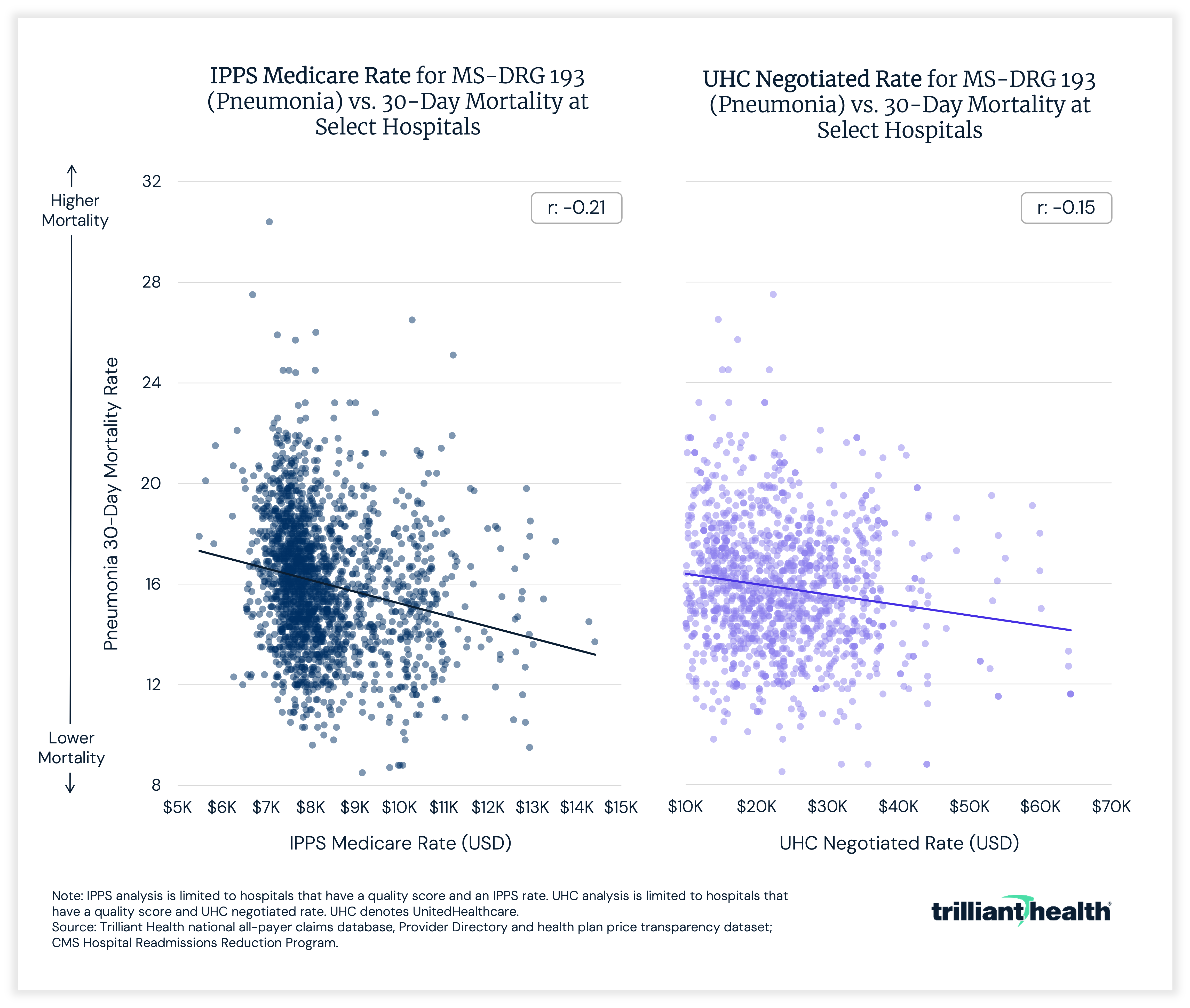
A perfect linear correlation of cost and quality in the above example would result in an r value of 1 or -1; an r value of 0 would signal no linear correlation at all. With r values ranging from -0.15 to -0.21, then, we can conclude that there is no meaningful correlation between cost and quality in the above examples. We have repeatedly demonstrated the absence of similar relationships for common healthcare services in different markets.
While the lack of value for money manifests most obviously in the hospital setting, the root causes of that deficit are myriad. The data in these graphs result from a combination of inconsistent provider quality, lazy payer contracting teams, cowardly HR benefits managers, mercenary health insurance brokers and hundreds of millions of Americans who have rejected personal responsibility for their health. Everyone is to blame, even if “greedy” hospitals and doctors are the scapegoats.
Health economy stakeholders are too often surprised to discover that people motivated by receiving votes or gaining listeners are prone to demagoguery, which is fundamentally based on creating a narrative, not articulating reality. The first problem for health economy stakeholders is the essential truth of accelerating healthcare prices:
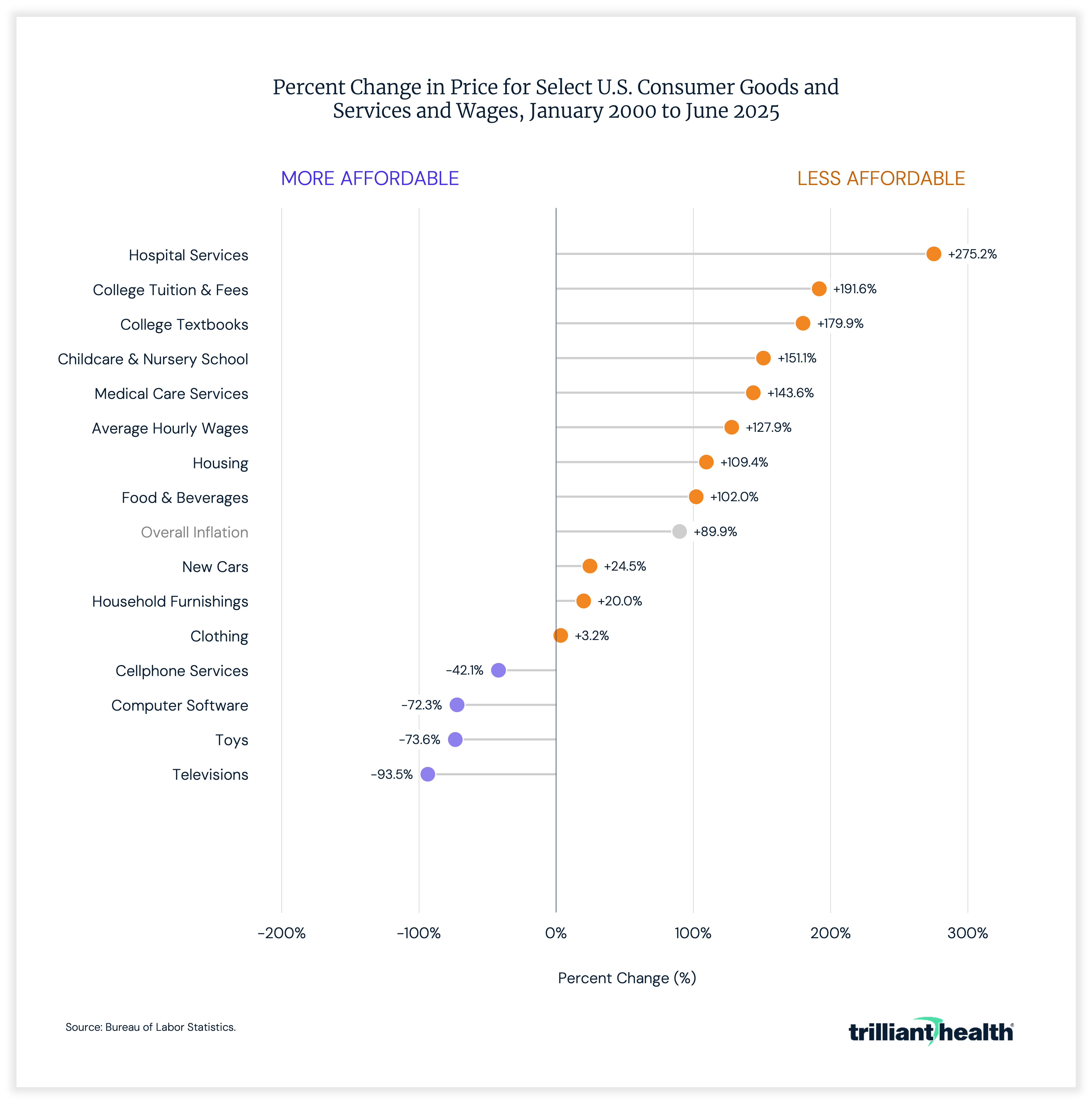
The second problem for health economy stakeholders is the standard industry response to “explain” the continuous increases. As I tell my team, if you are explaining, then you are losing, and the French Revolution offers a cautionary tale.
Instead of talking, health economy stakeholders would be wise to begin listening, seeking the signal in the noise. What frustrates politicians and policymakers and the public is that everyone wants to get what they pay for, and nobody – including you and me – really knows what we are paying for in healthcare. Even if the American public doesn’t have the data to prove this, they sense it, and they are increasingly frustrated about it…which is why Secretary Kennedy and Theo Von are discussing it.
In reality, consumers want more than value – they want a good deal. You want a good deal. I don’t know of many good deals in healthcare.
You should want to know whether your organization delivers value for money, even if you might not like the answer. Ignorance is not bliss.