Develop Service Line Strategies

Analyze the Competitive Landscape

Anticipate Future Patient Needs

Identify Sites To Capture Demand

Drive Loyalty Across the Patient Journey

Leverage Price Transparency Insights

Retain Patients in Your Network

Match Provider Supply to Demand

Acquire Commercial Patients

Capture Outpatient Demand

Target High-Value HCPs

Strengthen Provider Networks
We collect and organize the industry’s most comprehensive healthcare datasets.
See demand, supply and yield across the U.S. health economy

Validated Data for 2.9M Practitioners

Episodes of Care for 300M Patients

Negotiated Rates for Any Service at Any Location
Flexible solutions to fit your specific needs and workflow
Free resources to help health economy stakeholders use our products and data

Answer Key Questions in Seconds
AI Chatbot for Hospital Prices

Custom Enterprise-Level Analyses

Data-Driven Benchmarking Tool

Inform Data-Driven Strategies

Health Economy Survival Strategies

Product Guides and Feature Releases

Strategic guidance and commentary from our CEO, Hal Andrews
.png)
Analysis of trends shaping the health economy

Original research on trends shaping the health economy

Develop Service Line Strategies

Analyze the Competitive Landscape

Anticipate Future Patient Needs

Identify Sites To Capture Demand

Drive Loyalty Across the Patient Journey

Leverage Price Transparency Insights

Retain Patients in Your Network

Match Provider Supply to Demand

Acquire Commercial Patients

Capture Outpatient Demand

Target High-Value HCPs

Strengthen Provider Networks
We collect and organize the industry’s most comprehensive healthcare datasets.
See demand, supply and yield across the U.S. health economy

Validated Data for 2.9M Practitioners

Episodes of Care for 300M Patients

Negotiated Rates for Any Service at Any Location
Flexible solutions to fit your specific needs and workflow
Answer Key Questions in Seconds
Custom Enterprise-Level Analyses
Inform Data-Driven Strategies
Free resources to help health economy stakeholders use our products and data
AI Chatbot for Hospital Prices
Data-Driven Benchmarking Tool
Health Economy Survival Strategies
Product Guides and Feature Releases

Strategic guidance and commentary from our CEO, Hal Andrews
.png?width=171&height=239&name=2025%20Trends%20Report%20Nav%20(1).png)
Analysis of trends shaping the health economy

Original research on trends shaping the health economy
Women typically utilize more healthcare services than men according to the U.S. Department of Labor and make approximately 80% of the healthcare decisions for their families. As a result, it is commonly believed that if providers win the heart of Mom, they win the family.
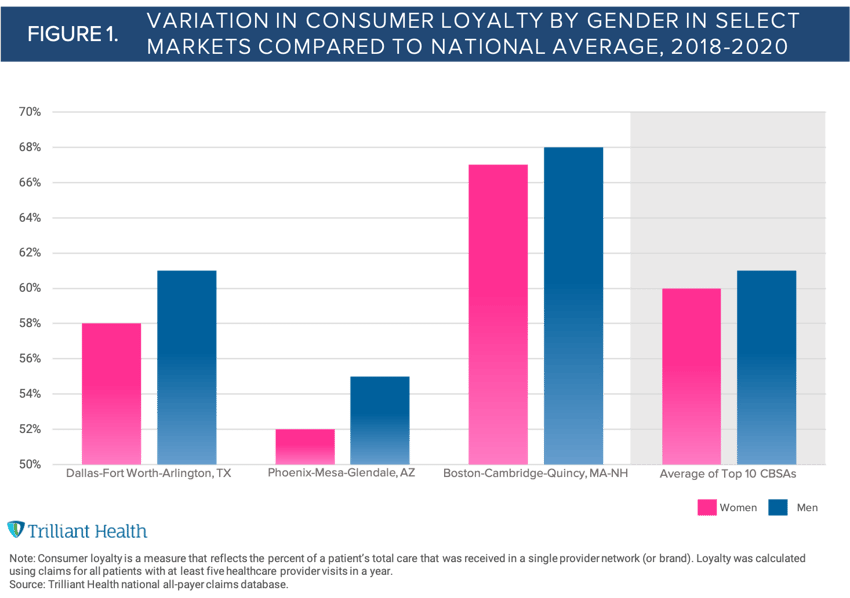
In reality, women are slightly less loyal to provider networks than men (Figure 1). While the one-percentage point difference may seem inconsequential, the translation to an individual’s total share of care is significant.
The trend of women being less loyal to provider networks than men is consistent across markets and over time. Across the largest CBSAs, provider loyalty among women ranges from 51% to 67%, and the loyalty differential by gender is as much as three percentage points in CBSAs like Dallas and Phoenix.
As the number of provider options continues to grow, especially with the emergence of several brands like Tia and Maven Clinic specifically catering to women’s healthcare needs and preferences, we can expect to see women split their healthcare interactions across more provider networks.
Whereas health systems have historically believed that the Moms who deliver their children at their facilities will be more likely to lead to downstream care in pediatrics and primary care with affiliated providers, loyalty trends would indicate otherwise.
We know from our prior research that loyalty is highest (70%) among newborns to age 10, suggesting strong alignment to family pediatricians. But with women serving as the “Chief Health Officer” of their families, we must consider that just because a provider network earns some share of care for the Mom, that loyalty does not necessarily extend across the full continuum of care needs.
In recent decades, many health systems have invested significantly in hotel-like amenities for Labor, Delivery, Recovery and Postpartum (LDRP) suites based on the myth of the mother as the loyal “Chief Health Officer.” Learning from telehealth utilization trends during the pandemic, a more cost-efficient and effective strategy is to utilize demographic and psychographic insights to earn and influence loyalty, particularly among commercially insured women.