Counterpoint
Hal Andrews | February 4, 2026On January 14, 2026, the Centers for Medicare and Medicaid Services released the NHE Fact Sheet reporting that national health expenditures were $5.3T in 2024. One of my eight loyal readers e-mailed that he was “struggling to understand how to reconcile” the NHE data with my repeated assertions over the past eight years that healthcare services utilization volume is flat to declining.
My first response was to remind him that a careful review of the NHE methodology reveals that it is modeled, a fancy word for made up, as I wrote about last year in a post titled National Health Expenditures: Down the Rabbit Hole and Through the Looking Glass. Second, I reminded him that much of the “intensity” cited by CMS in its “calculation” of NHE is attributable to fraud.
Our 2025 Trends Shaping the Health Economy Report highlighted the pervasive nature of fraud, waste and abuse in the health economy as one of six key trends. One example we noted was the waste, and likely fraud, of Medicare and Medicaid beneficiaries enrolled in more than one health plan: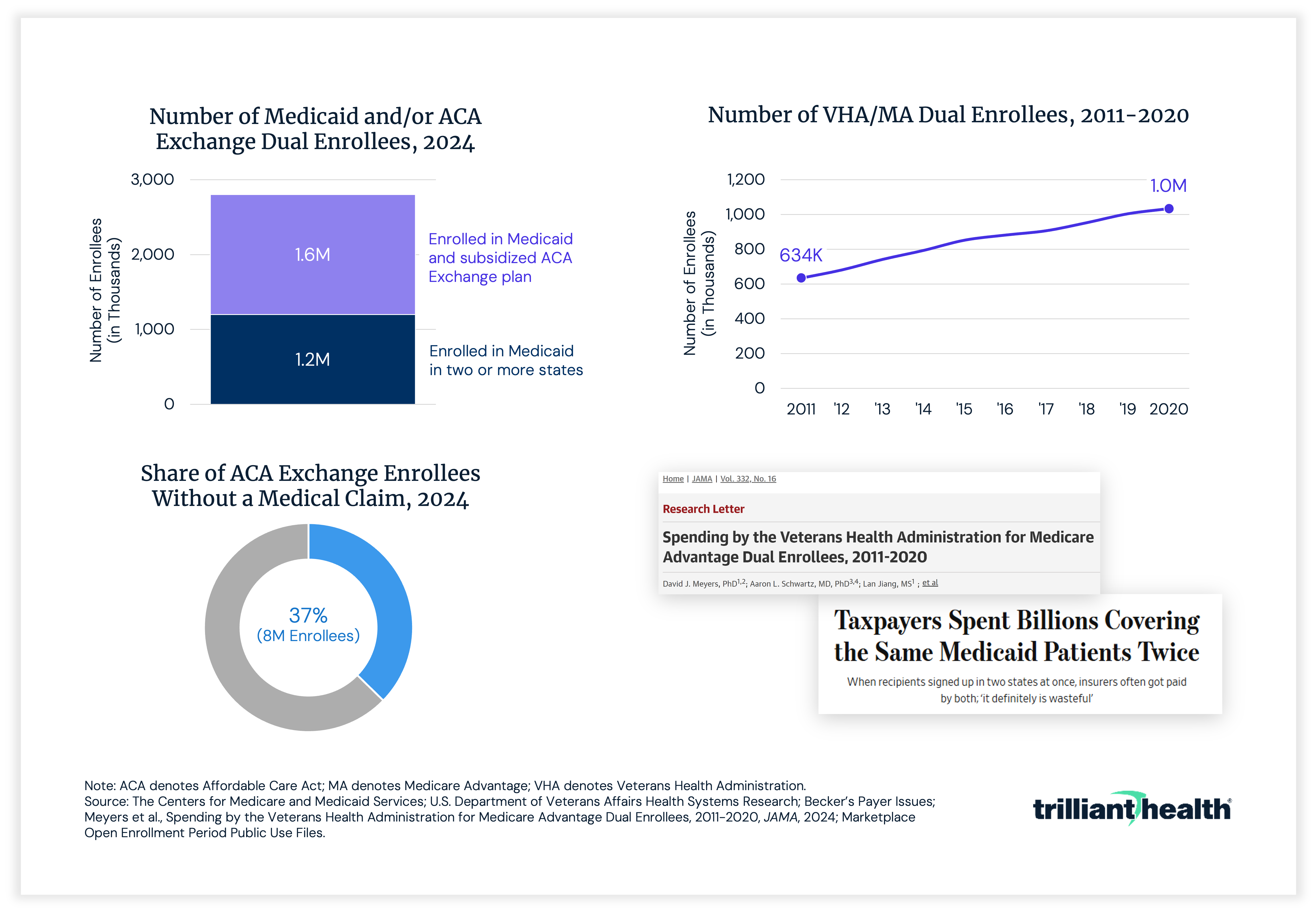
In hindsight, which I like to say is 20:15, we vastly understated that trend. On January 16, 2026, the Department of Justice issued this press release about False Claims Act settlements in Federal fiscal year 2025 with this highlight:
“Health care fraud remained a leading source of False Claims Act settlements and judgments. Of the more than $6.8 billion in False Claims Act settlements and judgments reported by the Department of Justice this past fiscal year, over $5.7 billion related to matters that involved the health care industry.”
In just the past 100 days, there have been numerous reports of healthcare fraud or waste or abuse of unimaginable scale:
- Department of Justice (DOJ) charges of applied behavior analysis (ABA) fraud in Minnesota
- Kaiser Permanente payment of $556M to settle DOJ allegations of False Claims Act violations related to Medicare Advantage coding
- Continuing allegations of massive fraud in New York’s Consumer Directed Personal Assistance Program
- Issuance of the Grassley Report by majority staff of the Senate Judiciary Committee finding that UnitedHealth Group “uses aggressive strategies to maximize its risk adjustment scores, appearing to leverage its size, vertical integration and data analytic capabilities to stay ahead of crackdowns by CMS aimed at counteracting overpayments due to coding intensity.”1
The Grassley Report cited dozens of examples of those “aggressive strategies,” such as this one:
“According to UHG, osteoarthritis affects ‘more than 80% of the population over the age of 60’ and can be diagnosed in patients/enrollees reporting joint stiffness and taking Tylenol as needed for pain.”2
The DOJ press release announcing the settlement of the Kaiser Permanente case included this:
“The civil settlement includes the resolution of certain claims brought in lawsuits under the qui tam or whistleblower provisions of the False Claims Act by Ronda Osinek and James M. Taylor, M.D., former employees of Kaiser. Under those provisions, private parties are permitted to sue on behalf of the United States and receive a portion of any recovery. The qui tam cases are captioned United States ex rel. Osinek v. Kaiser Permanente, et al., No. 3:13-cv-03891 (N.D. Cal.) and United States ex rel. Taylor v. Kaiser Permanente, et al., No. 3:21-cv-03894 (N.D. Cal.). The relator share of the recovery will be $95 million.”3
And then I wondered this: why aren’t there more whistleblowers?
Under the False Claims Act, a “qui tam” case allows a private “relator” to bring an action against entitles on behalf of the Federal government, with the relator receiving up to 30% of any award if the government wins the case.4 The size of the award is intentional:
“In 1986, Congress strengthened the False Claims Act by increasing incentives for whistleblowers to file lawsuits alleging false claims on behalf of the government. These whistleblowers, or qui tam, actions comprise a significant percentage of the False Claims Act cases that are filed.”5
The DOJ alleged “that, from 2009 to 2018, Kaiser engaged in a scheme to increase its Medicare reimbursements by pressuring physicians to add diagnoses after patient visits through ‘addenda’ to patients’ medical records.”6 So, in a decade-long “scheme” for which “Kaiser did not admit wrongdoing” but paid $556M to settle, only two employees knew enough to file a qui tam?7 Or was it that only two employees were ethical and courageous enough to file a qui tam?
There is a reason that False Claims Act enforcement “has traditionally focused on the health care and life sciences industries, with annual recoveries routinely exceeding $1 billion.”8 In absolute terms, the $5.7B of settlements in 2025 touted by the DOJ is a meaningful amount. In relative terms, 0.108% of $5.3T is infinitesimal.
How much of the $5.3T health economy is pure, unadulterated fraud? How many of the 18M Americans in the healthcare workforce are engaged in or have first-hand knowledge of healthcare fraud?9 How many of them have reason to suspect that their employer is engaged in healthcare fraud? How many of them are too afraid of getting fired to report it? Do any of them work for you?