Study Takeaways
- Among large employers (200 or more workers) offering health benefits, 60% agree or strongly agree that they can obtain sufficient information to understand the prices their plan pays to in-network providers and how those prices compare with other providers.
- One-quarter (25%) of large employers have not tried to access the claims data for their own plan enrollees, even though 95% of employers that have accessed claims data report that it has helped them make decisions about health benefits.
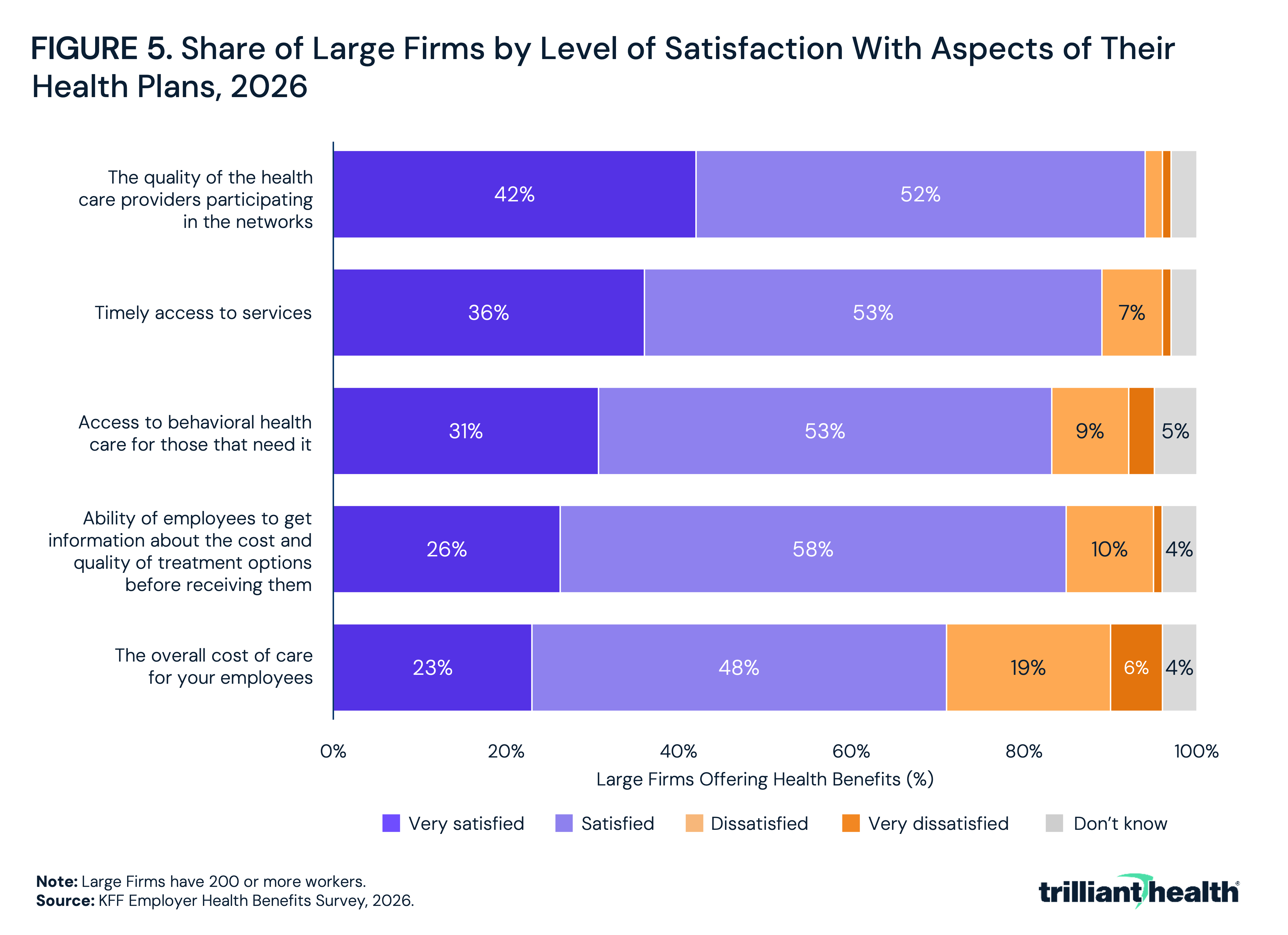
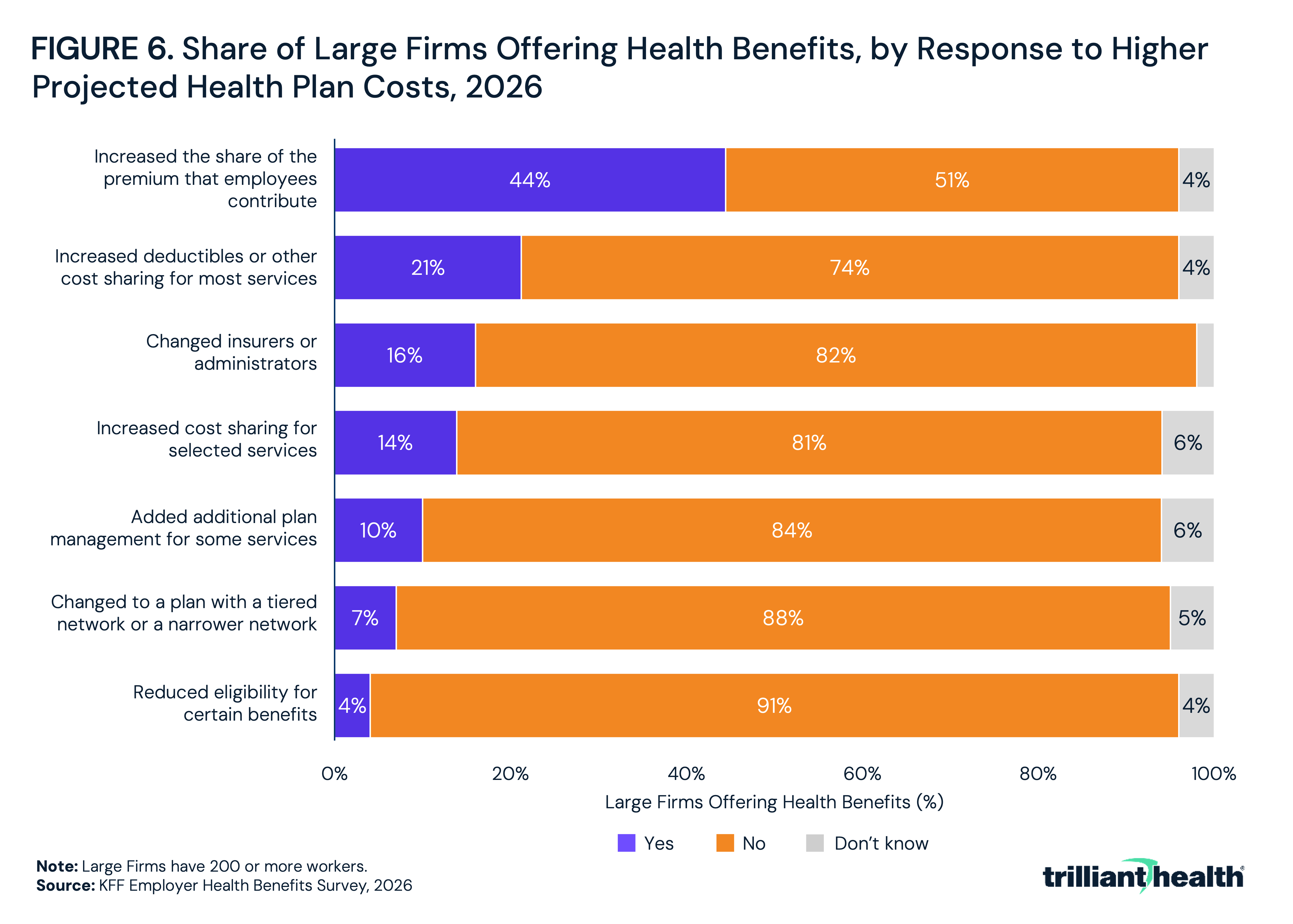
- Only 71% of large employers are satisfied with the overall cost of care, yet 44% responded to projected 2026 cost increases by increasing the share of the premium paid by workers, compared with 7% that moved their largest plan to a tiered or narrower provider network.
Employers finance health insurance coverage for 157M Americans under age 65, but for decades they have purchased that coverage without an understanding of the price or quality of the services that their employees received.1 However, Federal price transparency rules now require health plans to publish the rates they negotiate with every in-network provider, and employers have a statutory right to the claims data generated by their own enrollees. Given their fiduciary duty to act in the interest of plan participants, employers should be using this data to identify which providers deliver comparable quality at a lower price, the foundation of purchasing healthcare based on the concept of "value for money."
For the first time, the 2026 KFF Employer Health Benefits Survey asked employers about their ability to obtain information about the cost and use of services covered by their health plans. This study examines those responses and what they suggest about employer readiness for value-based benefit design.
Background
In the past five years, employer access to information about healthcare cost and quality has significantly increased. The Consolidated Appropriations Act, 2021 prohibits contract terms that restrict a plan sponsor's access to cost and quality information, including de-identified claims data.2 Since July 2022, the Centers for Medicare & Medicaid Services Transparency in Coverage rule has also required group health plans and insurers to publish negotiated rates for all covered items and services in machine-readable files, making visible the wide variation in what plans pay for the same service in the same market.3 Coupling an employer's own claims data with public negotiated rates can reveal actionable insights into utilization and costs relative to other plans.
Among covered workers, 71% are enrolled in self-funded plans, but this increases to 85% at firms with 200 or more workers.4 Under the Employee Retirement Income Security Act (ERISA), self-funded plan sponsors are fiduciaries who must act prudently and solely in the interest of plan participants and beneficiaries, for the exclusive purpose of providing benefits and defraying reasonable expenses of administering the plan.5 Since self-funded employers pay claims with their own funds, each has a clear financial incentive – and legal obligation – to identify and avoid low-value providers, as savings from directing enrollees to higher-value providers accrue to the employer, if not always to the employee. The fact that the average annual worker premium contribution for family coverage increased 26% over the past five years to $7,471 calls into question whether employers are using price transparency data effectively, if at all, as does the fact that the projected 8.2% average increase in health benefit costs per employee in 2027 would be the largest increase since 2003.6,7
Additionally, our prior research illustrates that healthcare cost and quality are not strongly correlated, indicative of a lack of value-based benefit design (Figure 1).8
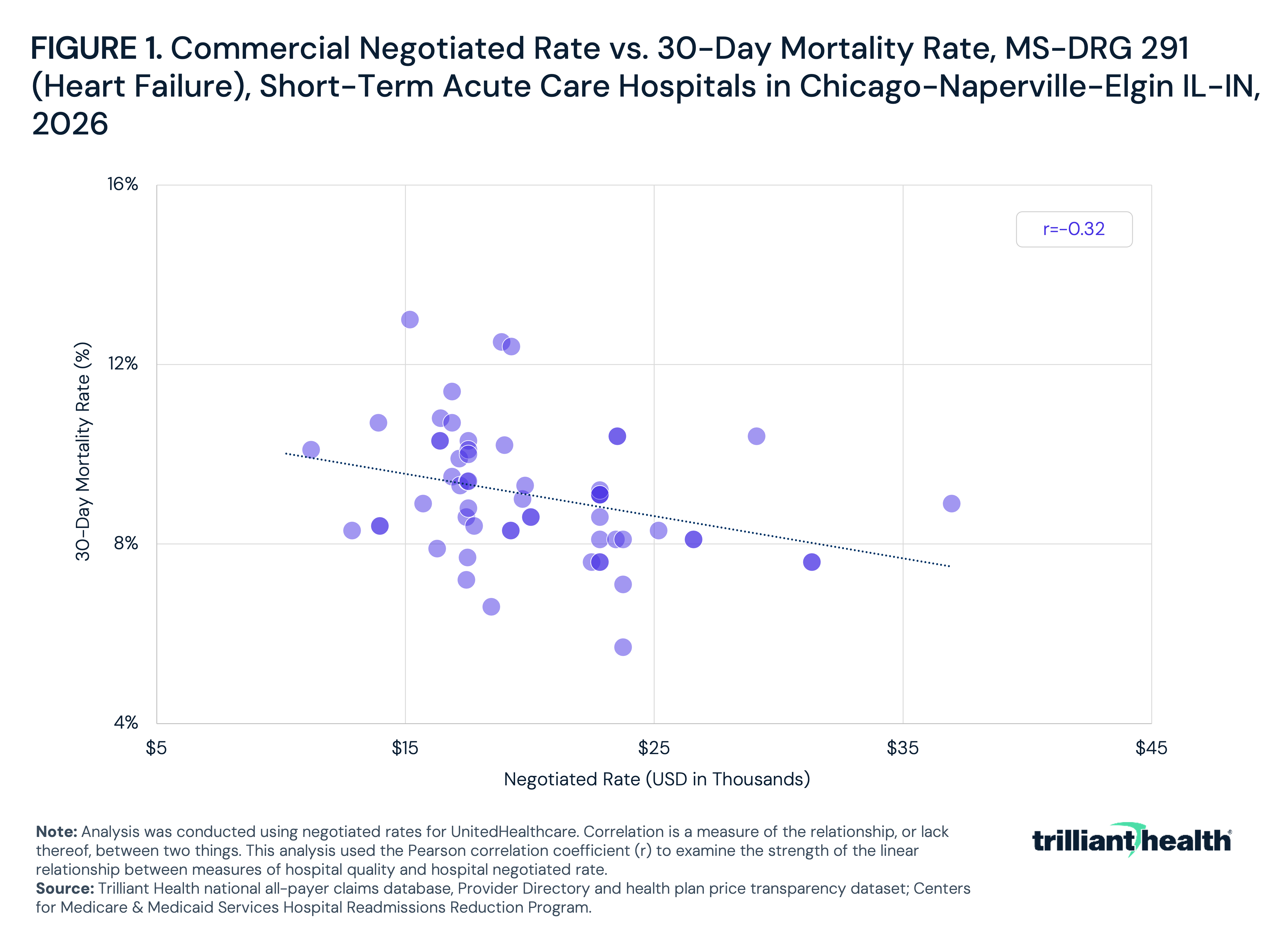
Contrary to industry belief, the largest savings available to employers come from steering employees away from a small number of high-priced providers at the service-line level rather than from narrowing networks. Realizing those savings requires employers to know what their plans pay and how those prices compare across providers.
This study examines employer-reported access to information on the cost and use of services based on the KFF 2026 Employer Health Benefits Survey and considers what those responses indicate about employer readiness to design benefits around value for money.
Analytic Approach
Leveraging the KFF 2026 Employer Health Benefits Survey, which reports findings from 1,937 randomly selected non-Federal public and private employers with 10 or more workers, this study examines employer data use. Questions on employer access to cost and utilization information were new to the 2026 survey and were asked of firms with 200 or more workers (i.e., “large employers”) that offer health benefits, in reference to the plan with the largest enrollment among their employees.
Findings
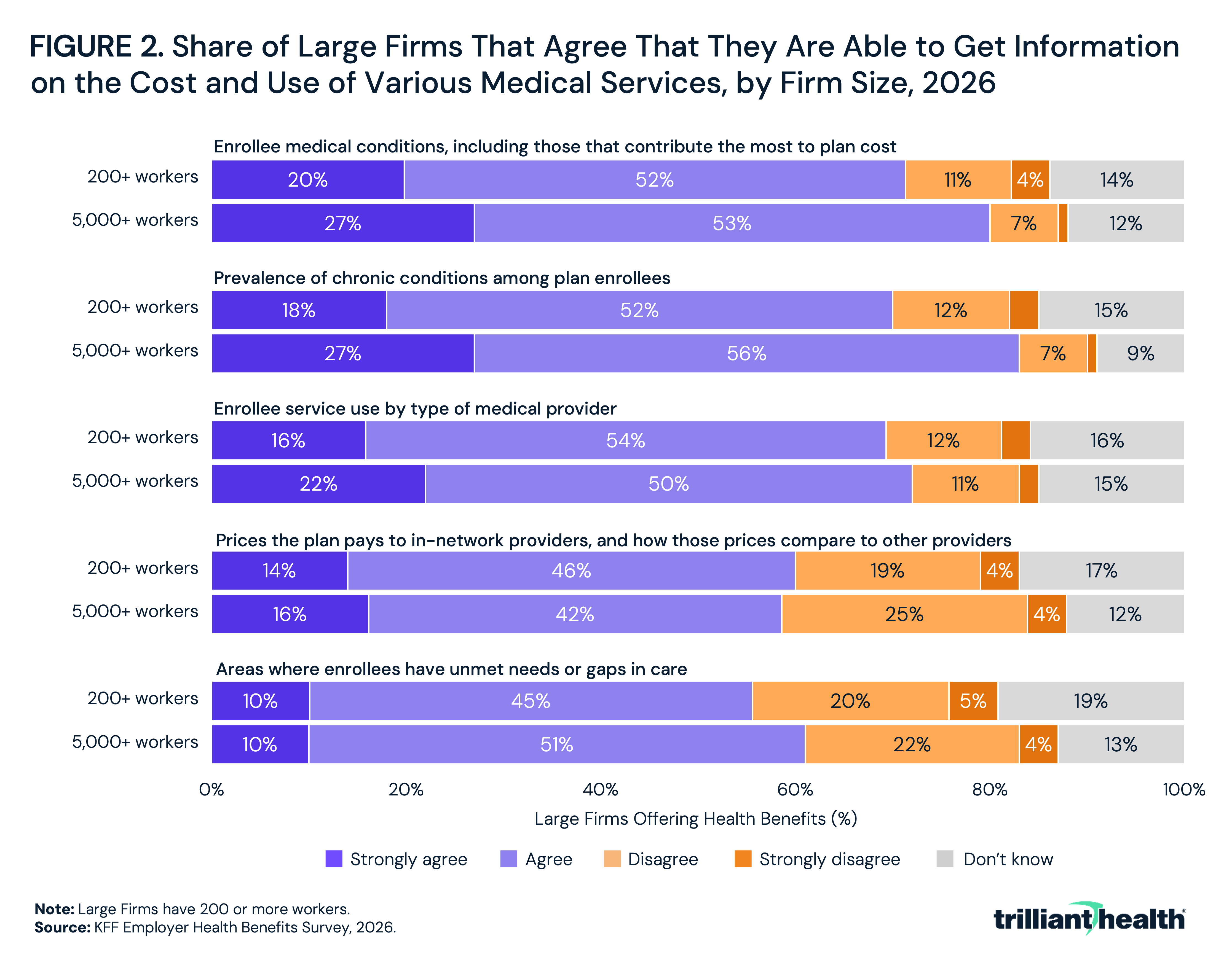
Large employers were less confident in their access to information on provider prices than in their access to information on enrollee health conditions and service use. Confidence in access to information on enrollee health conditions and service use increased with employer size, but confidence in access to information on provider prices did not. Among all large firms, 72% agreed that they could obtain sufficient information to understand the medical conditions of plan enrollees, compared with 80% of firms with 5,000 or more workers (Figure 2). Similarly, 70% of all large firms agreed that they could obtain sufficient information on the prevalence of chronic conditions among plan enrollees, compared with 83% of firms with 5,000 or more workers, and 70% agreed that they could obtain sufficient information on enrollee service use by type of medical provider, compared with 72% of firms with 5,000 or more workers. In contrast, 60% of all large firms and 58% of firms with 5,000 or more workers agreed that they could obtain sufficient information to understand the prices their plan pays to in-network providers and how those prices compare with other providers.
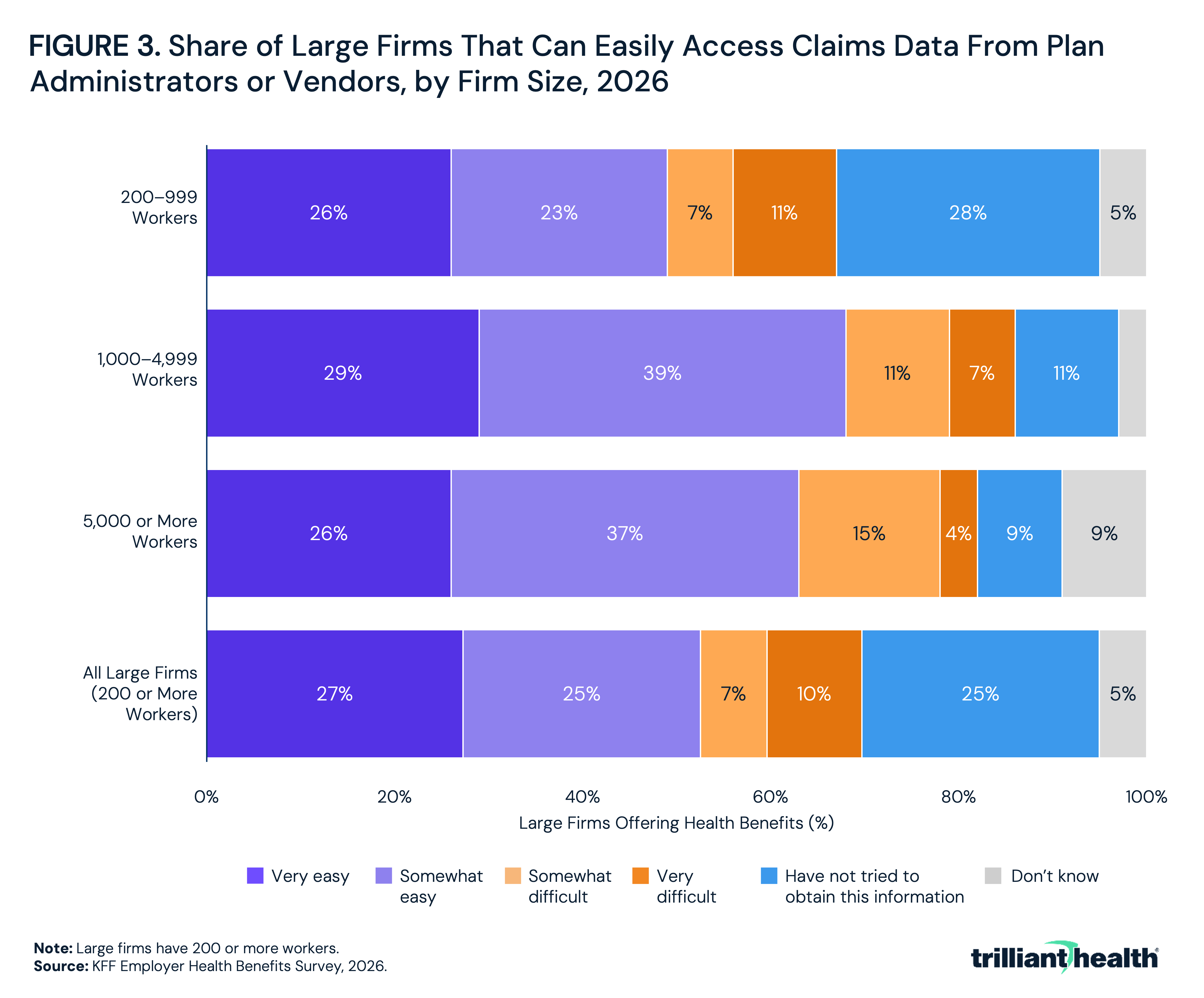
Among all large firms, 52% said that accessing claims data from their plan administrator or vendors was very or somewhat easy, 17% said it was somewhat or very difficult and 25% had not tried (Figure 3). The share that had not tried was highest among firms with 200 to 999 workers (28%), compared with 11% of firms with 1,000 to 4,999 workers and 9% of firms with 5,000 or more workers. Among firms with 5,000 or more workers, 19% reported that access was somewhat or very difficult.
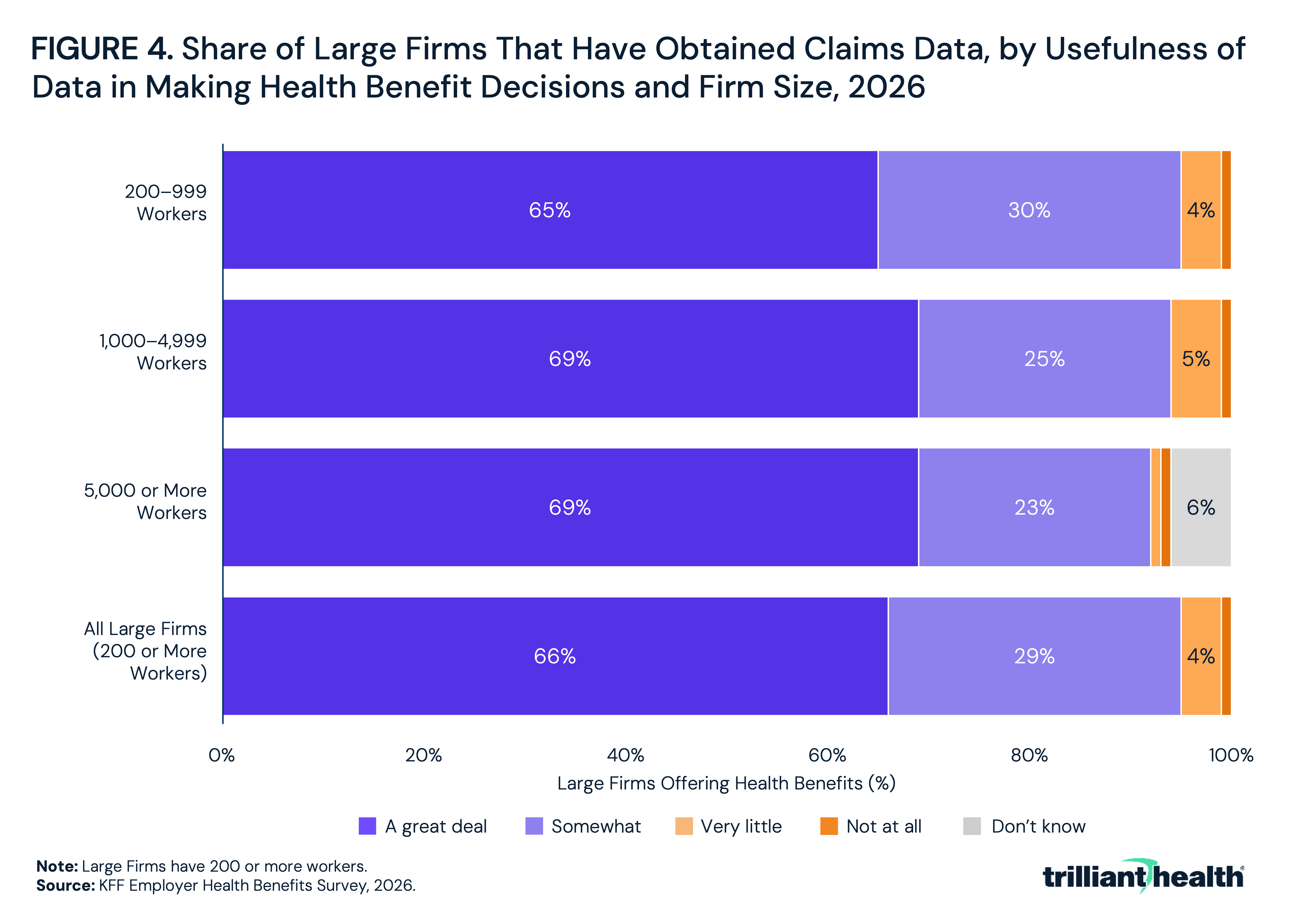
Among large firms that had accessed claims data for their enrollees, 66% said the data had helped "a great deal" in making decisions about health benefits, 29% said it had helped "somewhat," 4% said "very little" and 1% said "not at all" (Figure 4). The usefulness of claims data was consistent across employers, with 65% of firms with 200 to 999 workers and 69% of firms with 1,000 to 4,999 and 5,000 or more workers reporting the data had helped “a great deal”.
The overall cost of care remains a primary concern for large employers. Among large firms, 71% were satisfied with the overall cost of care for employees, compared with 94% that were satisfied with the quality of providers in their plan networks and 89% that were satisfied with timely access to services (Figure 5).
In response to projected 2026 cost increases, employers were more likely to shift additional costs to workers than change how care is purchased. Among all large firms, 44% increased the share of the premium paid by workers, and 21% increased deductibles or other cost sharing for most services. By comparison, 16% changed insurers or administrators, and 14% increased cost sharing for selected services. In addition, 10% added management requirements such as prior authorization, 7% moved their largest plan to a tiered or narrower provider network and 4% reduced or tightened eligibility for certain benefits (Figure 6).
Conclusion
Of the approximately 340M people in the U.S., 126M are covered by Medicare or Medicaid, where payment updates are set by Federal and state governments and have generally tracked inflation, and 27M are uninsured.9 In contrast, annual cost increases routinely exceed inflation in the commercial population, which includes approximately 157M Americans with employer-sponsored insurance and 14M enrolled in Affordable Care Act (ACA) Marketplace plans. Utilization has increased only modestly in recent years. As such, reducing the rate of increase in healthcare spending depends largely on controlling commercial health insurance rates, a conclusion the Congressional Budget Office reached in 2022.10,11 The officers and directors of every employer have general fiduciary duties of care under the laws of the state in which the employer is organized, and every self-funded employer has specific fiduciary duties under ERISA to limit the cost of employee health benefits.
In many ways, the 2026 KFF Employer Health Benefits Survey raises more questions than it answers. Interpreting the findings depends first on understanding the incentives of each stakeholder. Under the ACA, health insurers must spend at least 80% of premium revenue in the individual and small group markets and 85% in the large group market on medical claims and quality improvement, which effectively caps the share of premiums available for administrative costs and profit.12 Under that structure, insurers have limited financial incentive to reduce total healthcare costs, because their margin is earned on a premium base that grows as costs grow. Similarly, healthcare providers and life sciences companies have little incentive to reduce costs unless their revenue is tied to capitation. As a result, employers are the only health economy stakeholder with both the incentive and the leverage to limit the rate of increase in healthcare costs.
Over the past 20 years, steadily rising deductibles suggest that employers have relied on cost shifting, under which individual employees disproportionately bear the burden of perennial cost increases in commercial health insurance. Before Federally mandated price transparency, that strategy may have been the best, or even the only, option. Now that negotiated rates are publicly available, continued reliance on cost shifting suggests that employers lack the will to force meaningful change, and the KFF survey findings are consistent with that interpretation.
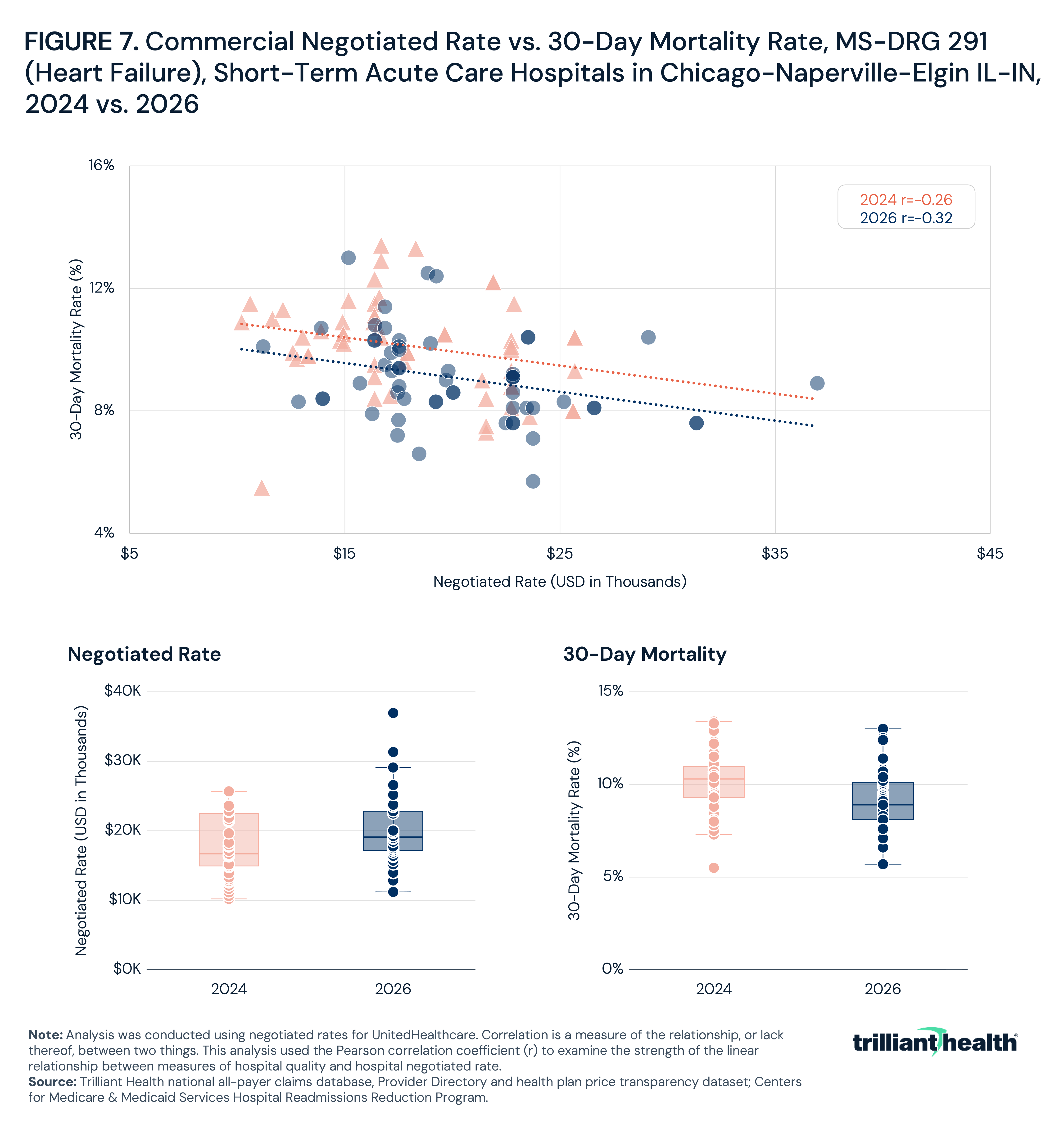
Most large employers report that they can obtain enough information to understand which conditions drive plan cost and where care is delivered. However, fewer report that they understand what their plan pays providers and how those prices compare across the market, which is the information most needed to increase care value. Very simply, employers are not forcing health insurers or providers to deliver value for money, with only 18% of large employers reporting having conducted or received an analysis using price transparency data in the 2025 KFF Employer Health Benefits Survey.13 That lack of effort manifests in the limited value improvement revealed in our recent analysis revealed in our recent analysis of the Chicago market (Figure 7).14
Even among the largest employers, those most likely to have dedicated benefits staff and the scale to negotiate, nearly three in 10 reported being unable to understand or obtain provider prices. At the same time, 25% of large employers either had not tried to access their own claims data or did not know whether they had, even as nearly all employers that did access it found it useful.
In aggregate, these responses suggest that employers are not upholding their fiduciary duties at the explicit expense of their employees. The Federal government, state attorneys general and stockholders are compelled by their statutory duties to ask why.
Given that 60% of large firms agreed they could obtain sufficient information to understand the prices their plan pays to in-network providers and how these prices compare with other providers, why have they not changed networks to give their employees access to the same providers at a lower cost? Our research has repeatedly demonstrated wide variation in commercial negotiated rates for the same procedure at the same provider. Yet in 2026, only 5% of firms moved to a tiered or narrower network, while 18% shifted more of the premium to their workers.
How is it possible that 40% of large firms do not think that they have sufficient information on provider prices? Among firms with 5,000 or more workers, those with the greatest resources and purchasing power, 29% disagreed that they could obtain this information. Hospital price transparency data are freely available in a single, uniform file. Because brokers generally owe employers no fiduciary duty, the responsibility rests with employers, who should refuse to work with any broker that cannot provide all available price transparency data before a provider network is selected.
While employers report high satisfaction with the quality of network providers, it is unclear what that satisfaction with quality is based on. Our research consistently shows that quality at the same provider often varies significantly by service line, so a hospital that performs well for one condition may perform poorly for another. In an industry where even confirming whether a provider is in network can be difficult, employer satisfaction with provider quality likely reflects perception more than measured performance.
The British epidemiologist William Farr observed that “death is fact, all else is inference.” Post-discharge mortality is an objective, publicly reported outcome and, paired with negotiated rates from price transparency data, allows employers to compare value across hospitals, as the Chicago heart failure analysis illustrates (Figure 1). Why, then, are employers not using it to help employees understand value? And how can an employer claim to prioritize the welfare of its employees if it does not discourage them from using hospitals with high post-discharge mortality for planned care?
The survey indicts large employers for failure to uphold their fiduciary duties to their employees and stockholders. Instead of holding their brokers accountable to deliver high-value provider networks, which would generate actual savings, employers continue to shift costs to workers through higher premium contributions and deductibles. Because employer-sponsored insurance – the largest source of coverage in the U.S. - is subsidized by taxpayers via a tax deduction for employer health benefits, the unchecked growth in commercial healthcare costs adds directly to the fiscal pressures facing the Federal government and, ultimately, threatens the solvency of the United States.
Get the latest insights delivered to your inbox.
Related Research
Was this shared with you?
Subscribe for weekly insights.
Subscribe to receive weekly insights from Trilliant Health's Research Team
Interested in citing our research? Please follow this guide.
