Counterpoint
Hal Andrews | November 4, 2026From a truly consumer-centric perspective, there is no industry more curious than the U.S. health economy, which can be summarized thus:
"Patients receive goods and services, frequently of indeterminate price, quality and efficacy, that they don’t want and cannot afford from businesses they don’t trust."
The exception to the rule? The expectant mother who, with a clear understanding of what is about to happen, is desperate to be admitted to the hospital where her OB/GYN has admitting privileges, price transparency be damned.
Why this circumstance has persisted for decades is simple: patient need has eclipsed consumer desire. Why this cannot continue to persist is equally simple: affordability has begun to eclipse need.
Herb Stein noted that “if something cannot go on forever, it will stop,” and this will eventually stop:1
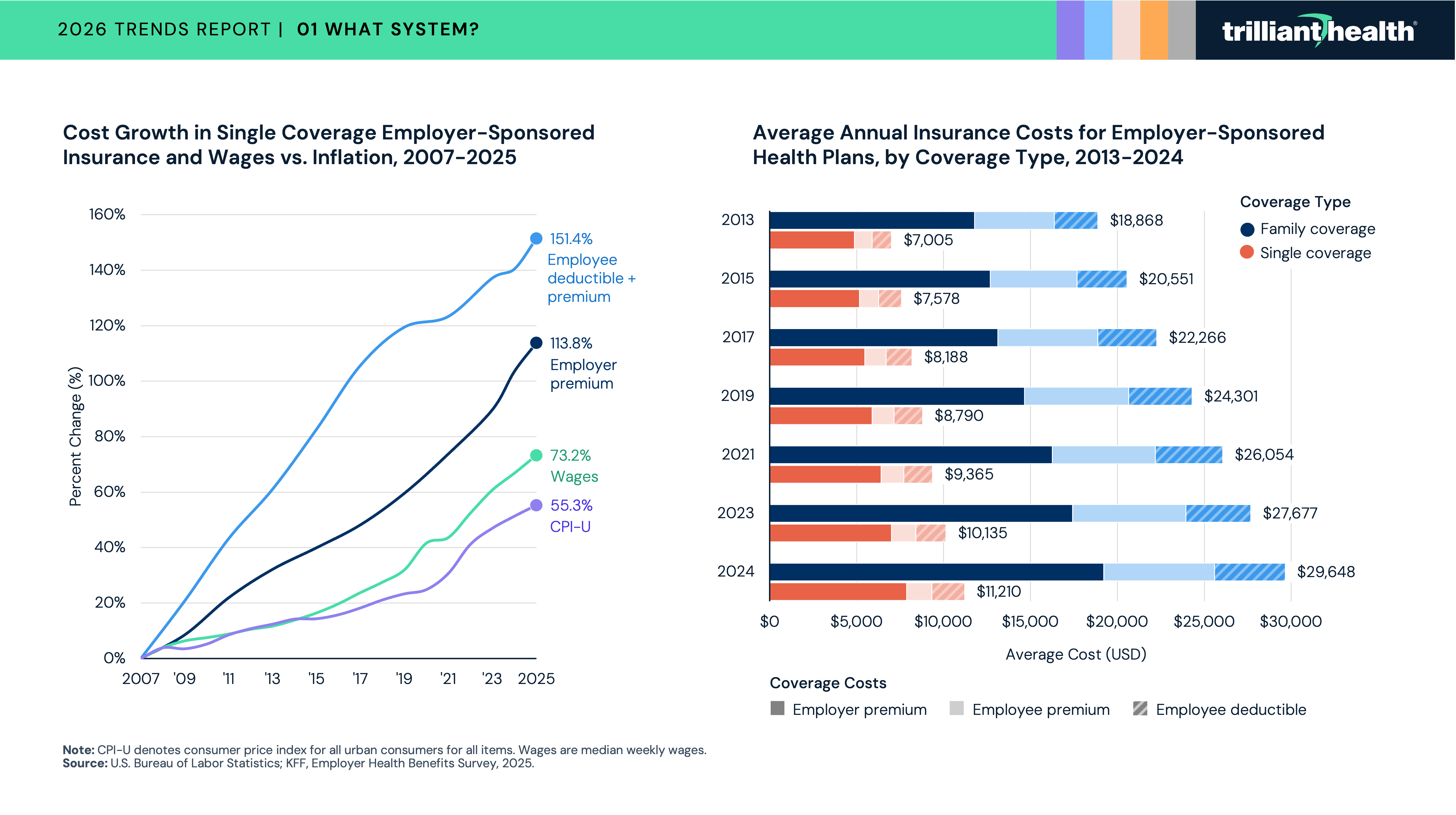
Ernest Hemingway may provide the best framework for how, and when, it will stop: “Gradually, and then suddenly,” as befits an industry that is the most powerful catalyst to the looming bankruptcy of the United States of America.2
What might happen next?
In the summer of 1997, I organized a small meeting of my peers in the Nashville healthcare industry, a group of 12-15 managers and directors in their late 20s and early 30s working for healthcare providers, management companies, suppliers and consultants. The organizing principle was that our bosses and mentors – Tommy Frist, Jr., Charlie Martin and Joel Gordon, among others – had thrived in an era of cost-plus reimbursement, while our careers would be defined by prospective payment. All we really knew was that we didn’t understand the long-term implications of the Balanced Budget Act of 1997 (BBA 1997) and the Kennedy-Kassebaum Act, aka the Health Insurance Portability and Accountability Act of 1996 (HIPAA), but we suspected that our success would be muted compared to our mentors. Thirty years later, I can confirm that our suspicions were correct.
Three weeks ago, I was invited to provide an overview of A Tragedy of the Commons: 2026 Trends Shaping the Health Economy to a group of ~60 leadership residents of a large health system. As I spoke, I had a flashback to the inaugural meeting of my peers in 1997, followed by an epiphany that I shared with the group – just as my career was defined by prospective payment and HIPAA, their careers will be defined by price caps.
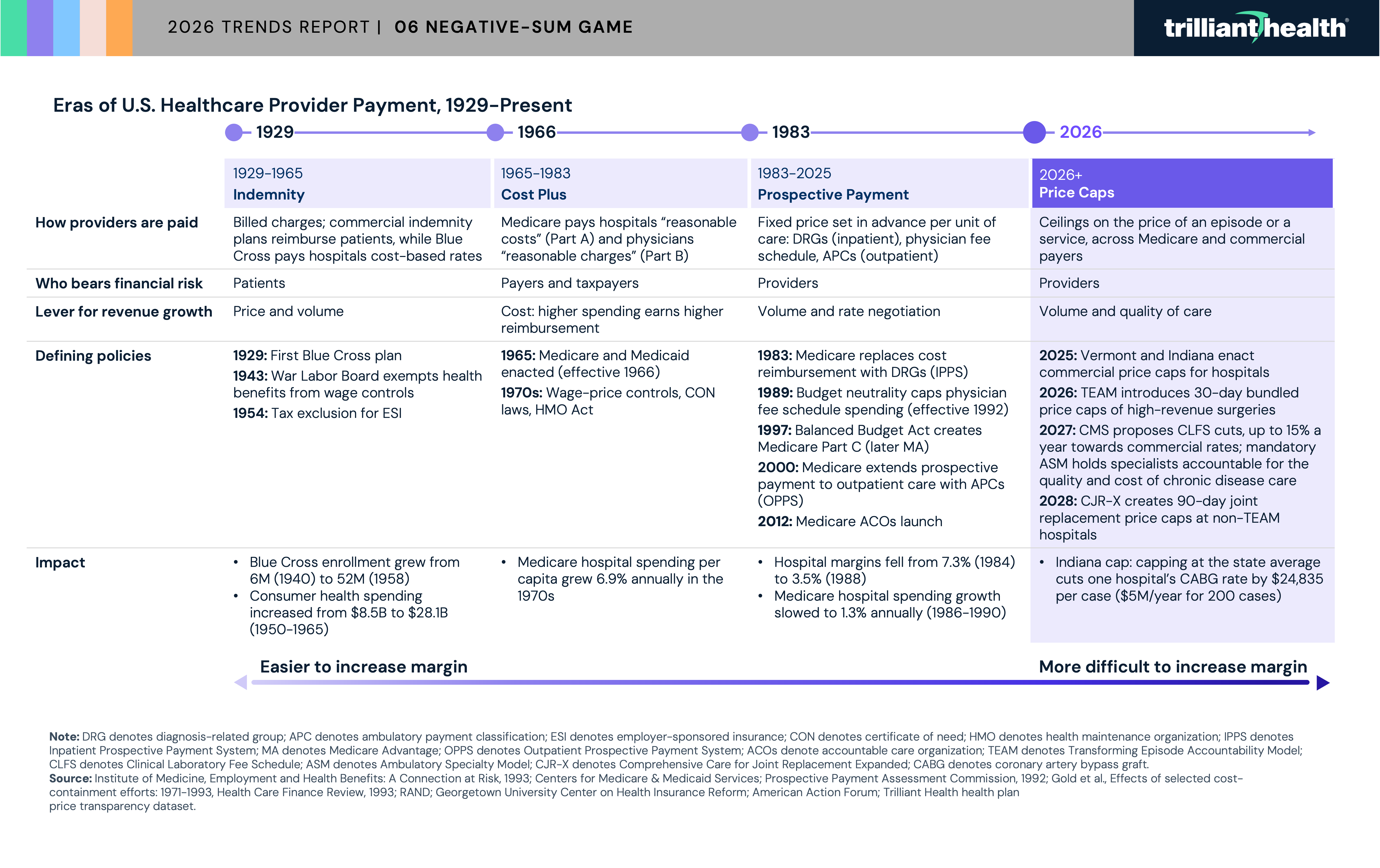
In November 2024, I wrote that the re-election of President Trump and the election of Mike Braun as Governor of Indiana suggested that “lowering healthcare costs is a priority at both the Federal and state levels.”In March 2025, I described how price caps would create a “doom loop” for health economy stakeholders. What informed these posts and others was this seminal report published in 2022, in which the Congressional Budget Office (CBO) telegraphed the era of price caps.
If you subscribe to all our research, you will know why the CBO found that price transparency would only have a “very small” impact, which I summarized here:
“…the fundamental flaw in healthcare price transparency for consumers…is the limited actionability of price transparency after the employer’s selection of a provider network and the employee’s selection of a benefit tier…”
Employers obviously could choose a provider network based on which network would provide the most value for their employees instead of choosing the health plan or third-party administrator that generates the highest commission for their benefits broker. On several occasions in 2023, I wrote about the lack of courage – and legal liability – of employers who fail to force brokers to make simple changes like that. Nature abhors a vacuum, and employer indifference to leveraging price transparency makes the CBO’s conclusion inescapable.
Similarly, longtime readers will know that the Department of Justice, Federal Trade Commission and a multitude of health economists are wrong about “anti-competitive” hospital mergers:
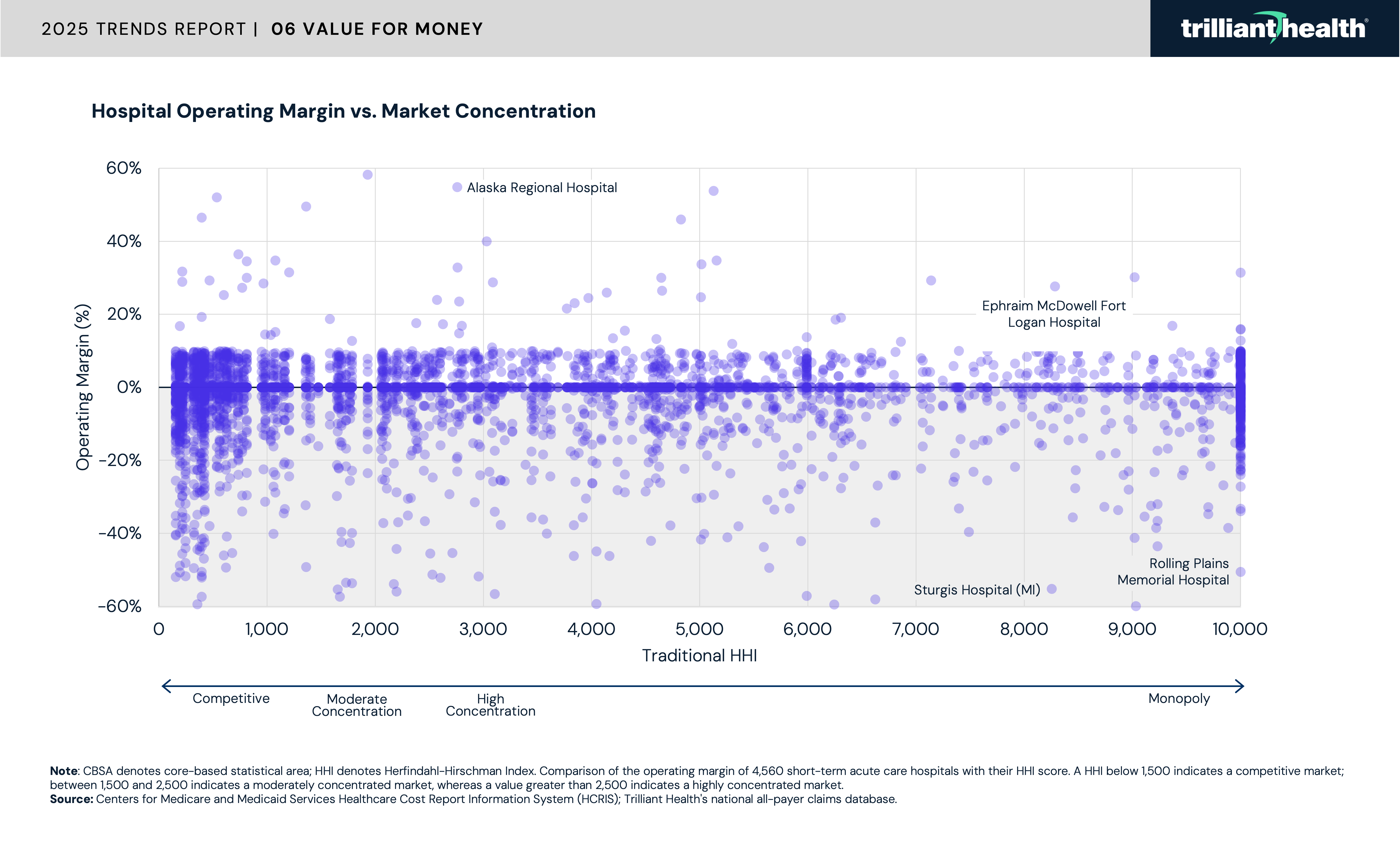 But understanding why the CBO doesn’t think competition or price transparency can bend the healthcare cost curve is different than understanding the CBO’s narrow focus on price. If you haven’t read the CBO report, you should read it carefully. If you do, you will find that the only notable reference to quality in the context of price caps is this:
“Lowering the prices paid by commercial insurers would have other effects as well, such as reducing income for some providers and improving financial outcomes for people with commercial health insurance. It could also result in decreases in some aspects of the quality of health care and patients’ access to care.”3
(Emphasis added)
Peter Drucker noted that “most innovations in public service institutions are imposed on them either by outsiders or by catastrophe.”4 For avoidance of doubt, the Federal government is about to sacrifice quality at the altar of price, the result of which is inevitable: American healthcare consumers will receive widely different value without knowing it, the always inevitable result of variable quality at a fixed price.
From a historical perspective, Federal price caps on healthcare services have been a feature of the U.S. health economy since the introduction of inpatient prospective payment under the Social Security Act Amendments of 1983, followed by outpatient prospective payment under BBA 1997. More recently, the Inflation Reduction Act introduced a price cap on Federal drug spending.
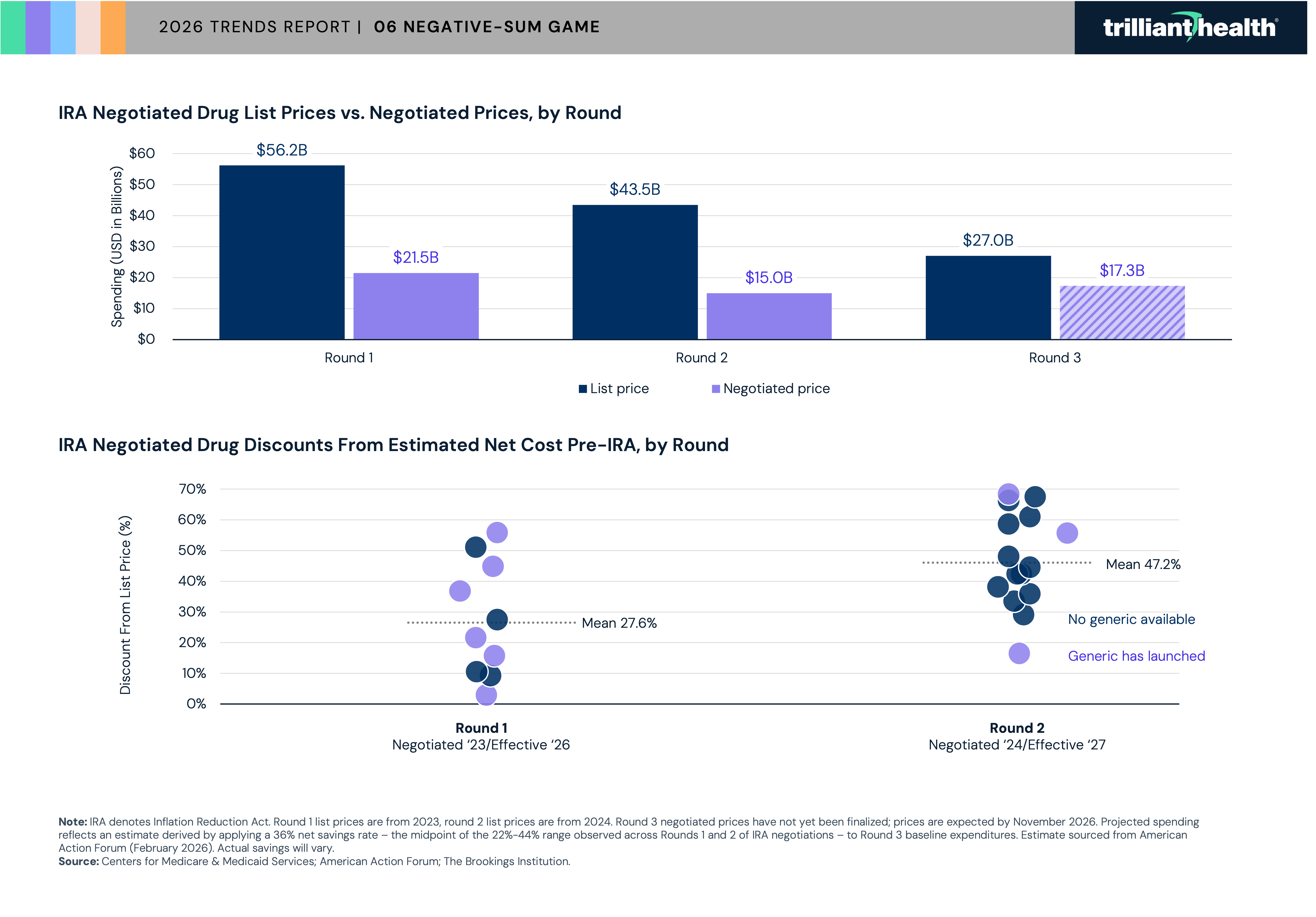
Similarly, a variety of state price caps have been implemented or are being considered.
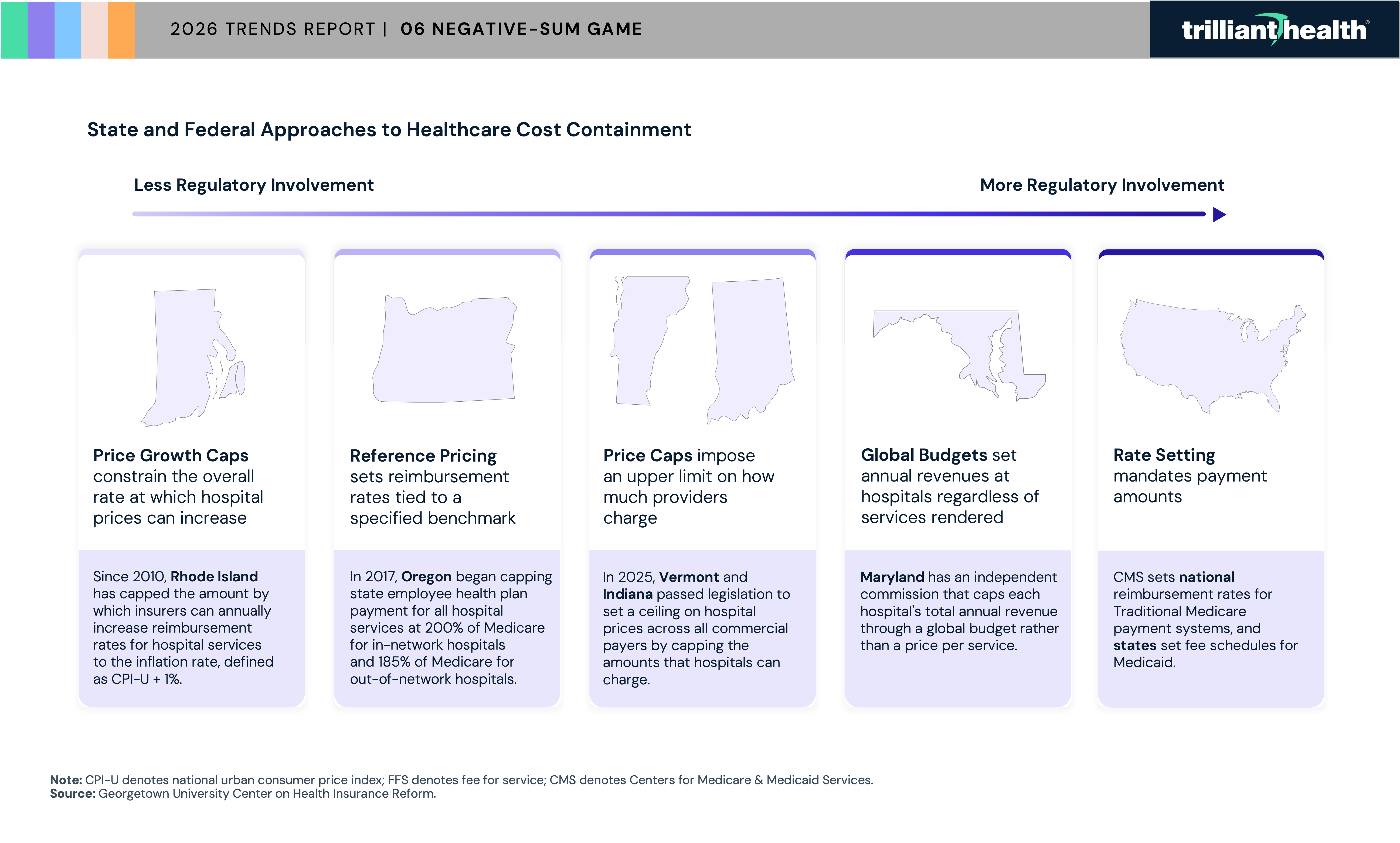
Less obvious than Federal or state legislative price caps are those that are administrative in nature:
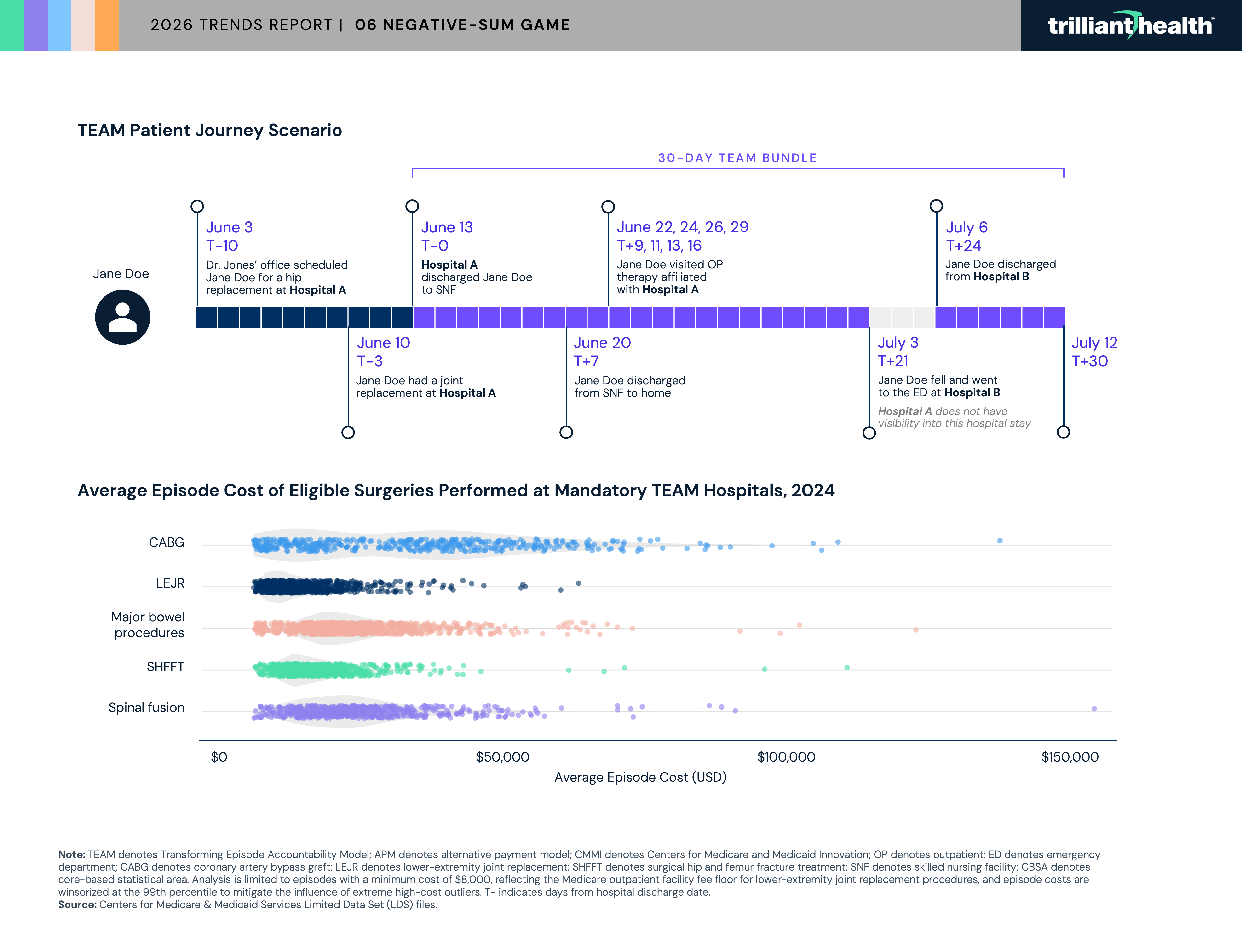
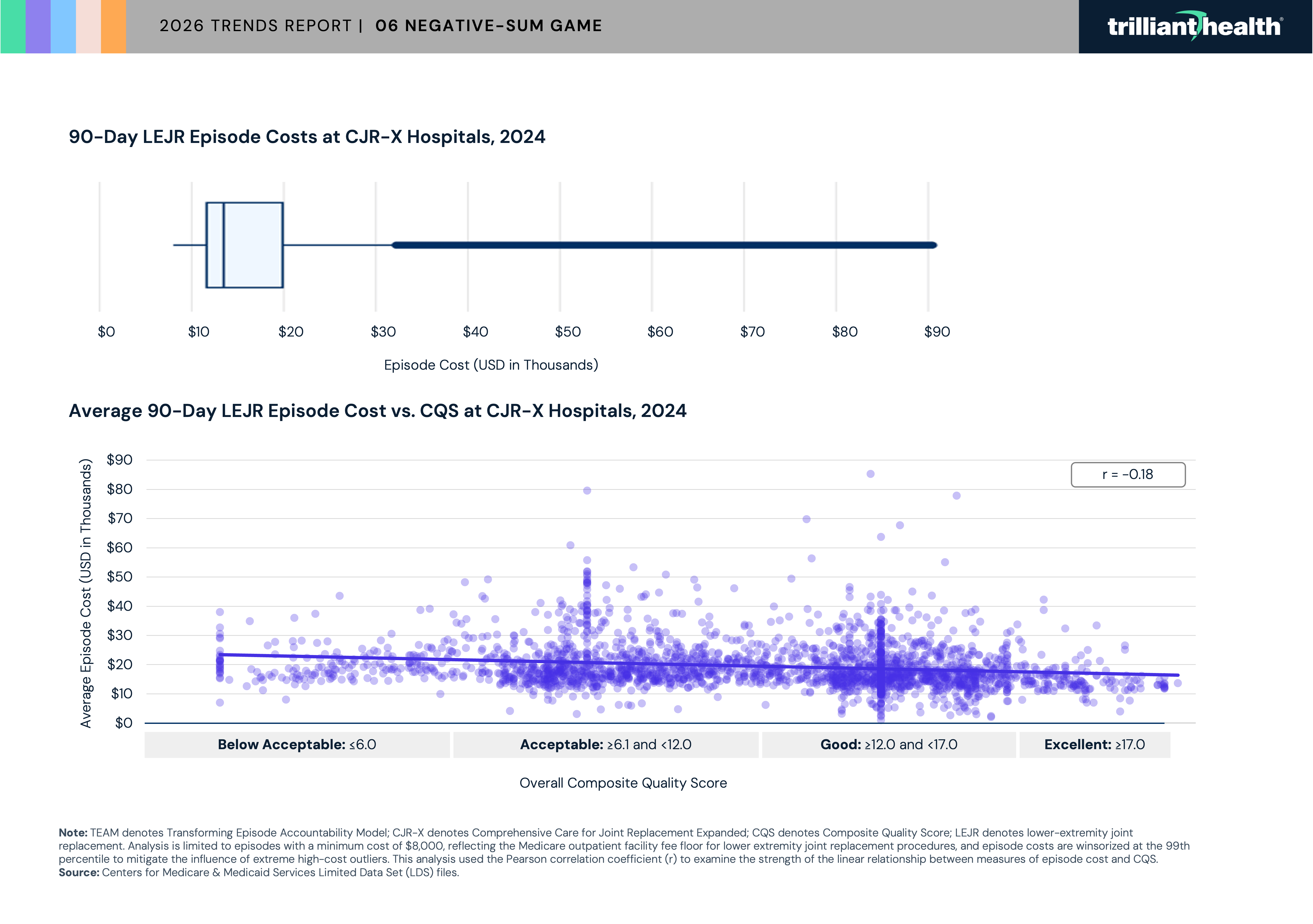
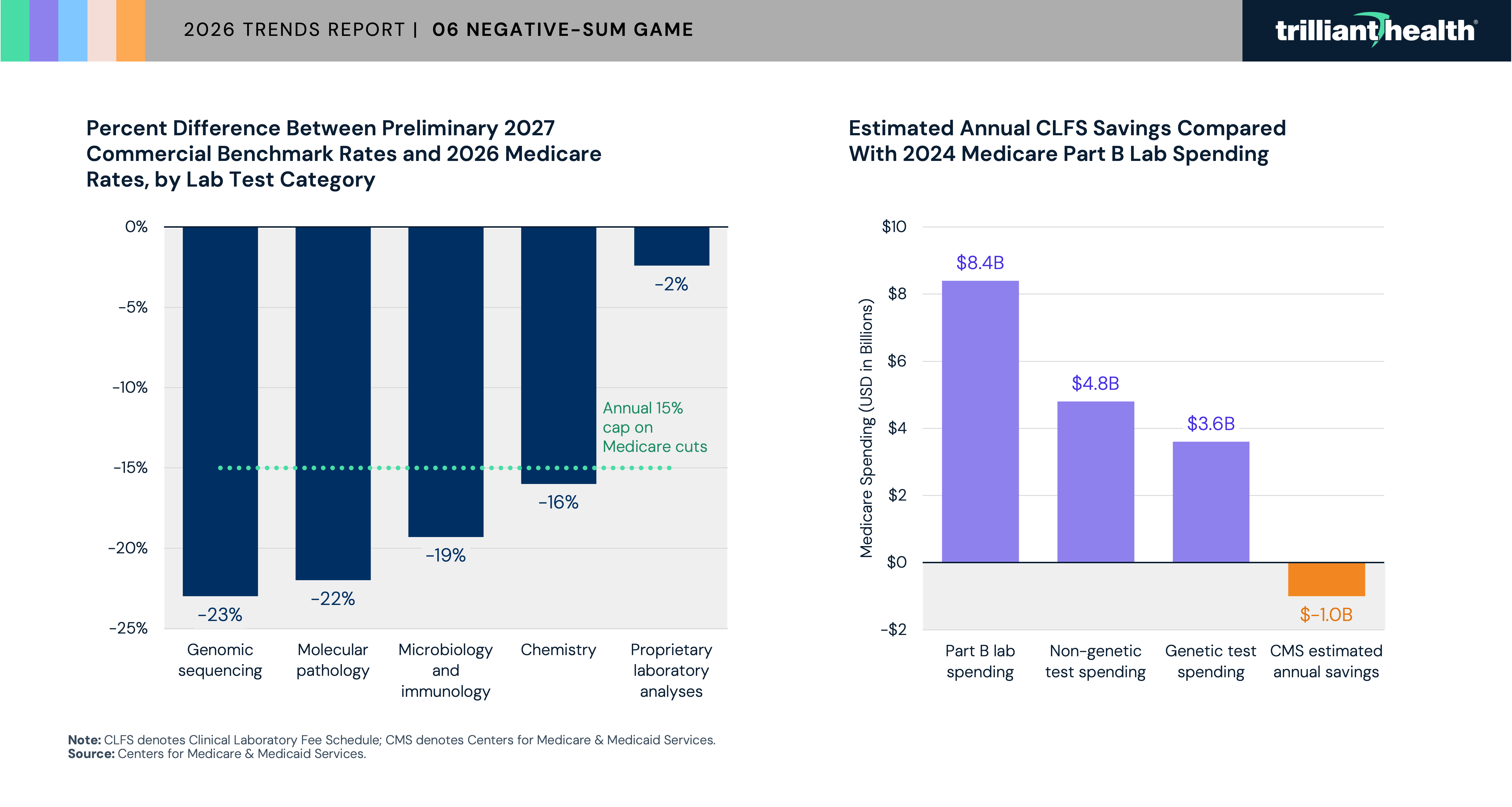 Paradoxically, health economy stakeholders face a future of price caps because they have failed to deliver value for money, which is the only way to avoid such a future.
In the Data Advantage 2009 Hospital Value Index™, my co-author John Morrow and I wrote this:
"Value in healthcare is the same thing as value with any other commodity, product or service. Value is the combination of what you receive in exchange for what you paid and the likelihood that you will want it again. The elements of healthcare value include price, quality, efficiency, effectiveness, outcomes, process, experience and on-going perception, to name a few points on our radar. Inherent in value is the cost required to create the good, and the relationship of that cost to its price, demand and availability.
Some people believe that paying $150,000 for a Bentley automobile is a good value because of the quality of materials and craftsmanship involved in production, as well as its brand reputation. Other people think that buying ten Bic pens for $3.00 is also a value, because Bic pens are reliable, efficient and easily replaced. Value in healthcare is difficult because patients are more like Bentleys (they are all different) than Bic pens (they are all the same). Yet a laboratory lipid panel processed by a Bioscanner 2000 with automated output, normal range benchmarks and results reporting is analogous to the Bic pen, demonstrating that some components of healthcare are quite commoditized…
To date, most VBP reform has focused on quality and patient satisfaction. We believe that value is broader than just quality and patient satisfaction. In particular, we believe that price and cost are critical elements of value, and we assume that Congress will ultimately agree. As a result, we compiled many of the industry recognized and established methods for evaluating qualitative performance: CMS Hospital Process of Care Measures, HCAHPS, AHRQ PSI scores, Hospital Readmission rates, and CMS 30-Day Post-discharge Mortality scores. We have merged those scores with efficiency measures from hospital costs and affordability measures, using market baskets of the most routine of hospital services. At the local level, we have added consumer opinion about preference to create a single composite score of value. This is Data Advantage’s Hospital Value Index™: our interpretation of outcomes per dollar, or value for money."
What we failed to realize in 2009 was that the Federal government would routinely fail to enforce compliance with the mere reporting of measures, much less implement reimbursement reform that was true “pay for performance.”
Nevertheless, since 2009 I have spoken to thousands of healthcare executives and written more than 100 blog posts, articles and white papers about value for money in healthcare, specifically distinguishing it from value-based care. Value-based care does not deliver value for money, as I explained in May 2023:
“In any event, employers don’t want value-based care and don’t pretend to know what it means, in contrast to the thousands of consultants, policy wonks and entrepreneurs prattling on about it for the past two decades. The phrase ‘value-based care’ is almost Orwellian, meaning virtually anything and therefore almost nothing.
Applying Porter and Teisberg’s framework above, value-based care does not create value for the ultimate payer, whether the employer or the Federal government, but simply allows that ultimate payer to cap its financial exposure. Why? Value-based care participants focus on minimizing cost after negotiating the revenue pool from the ultimate payer to maximize marginal income on their share of the available funds, aka ‘sub-capitation.’
Value-based care never delivers maximal cost-effectiveness for the ultimate payer, which the British call ‘value for money,’ a concept enshrined in The NHS Constitution for England.”
In every sector of the U.S. economy other than the health economy, value for money is table stakes, especially for consumer-focused businesses. Most health economy stakeholders have paid lip-service to being consumer-focused for decades, as evidenced by the most prominent manifestation of “healthcare consumerism.”
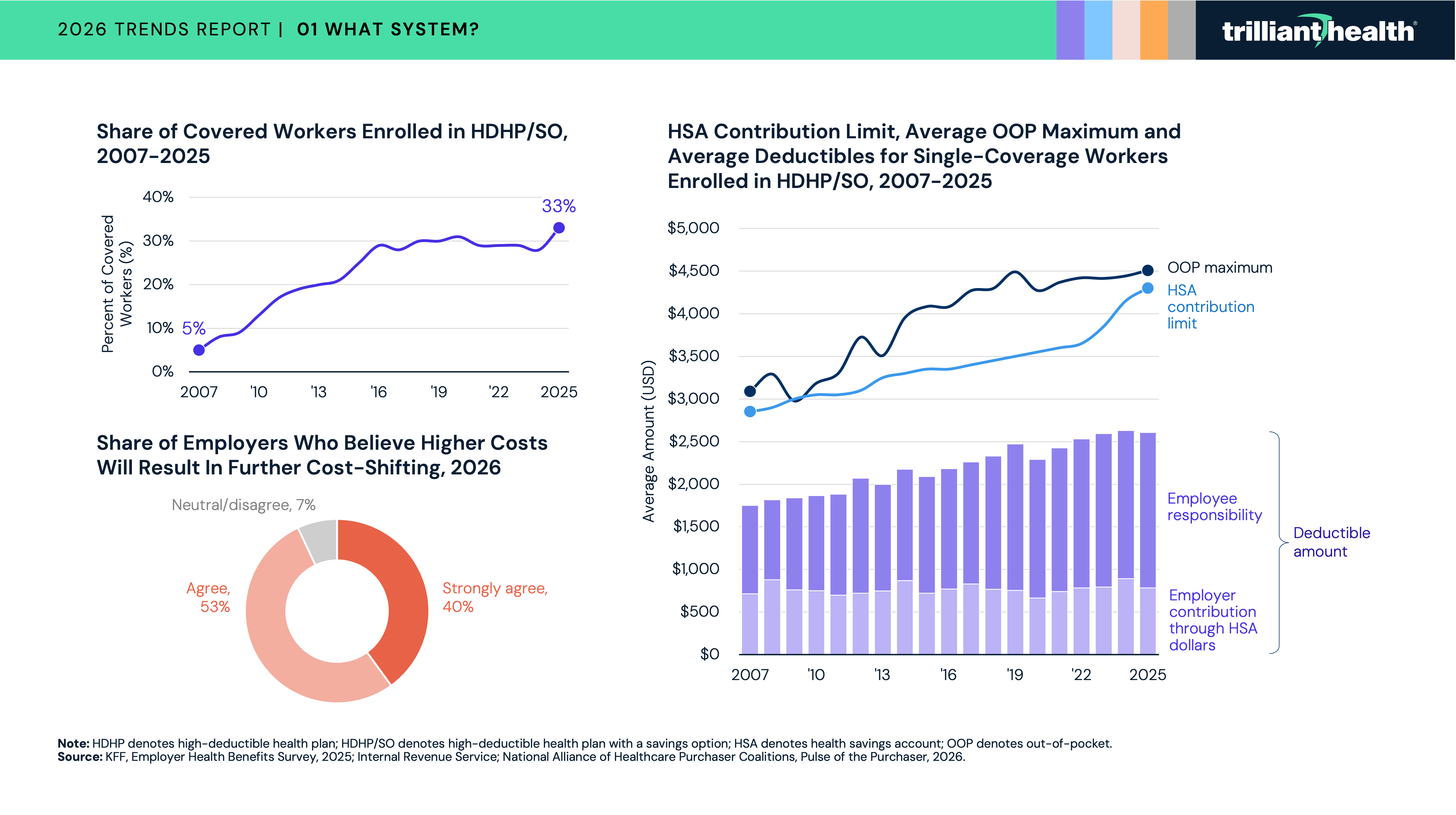
What if real consumerism, the kind where health economy stakeholders must deliver value for money to the people the industry calls “patients” and “enrollees” and “attributed lives,” determines the winners and losers in the health economy?
CHOICE Arrangements might be the catalyst.
“CHOICE Arrangements (formerly known as the Individual Coverage Health Reimbursement Arrangements, or ICHRAs) are a way for employers to provide tax-free reimbursements to employees for qualified medical expenses up to a set annual amount, including monthly premiums and out-of-pocket costs, without offering traditional group health coverage. To use the funds, employees must have their own individual health insurance plan (like one from the Marketplace).”5
Two years ago, I hosted a “fireside chat” with Tony Miller, an innovator in financing healthcare benefits who was the founder of Definity Health and co-founder of Bind (now called Surest). Tony told the audience that employers who did not move their employees to ICHRA (now CHOICE Arrangements) were “stupid.” As often happens in the real world, the “little guys” have been the first to heed Tony’s advice.
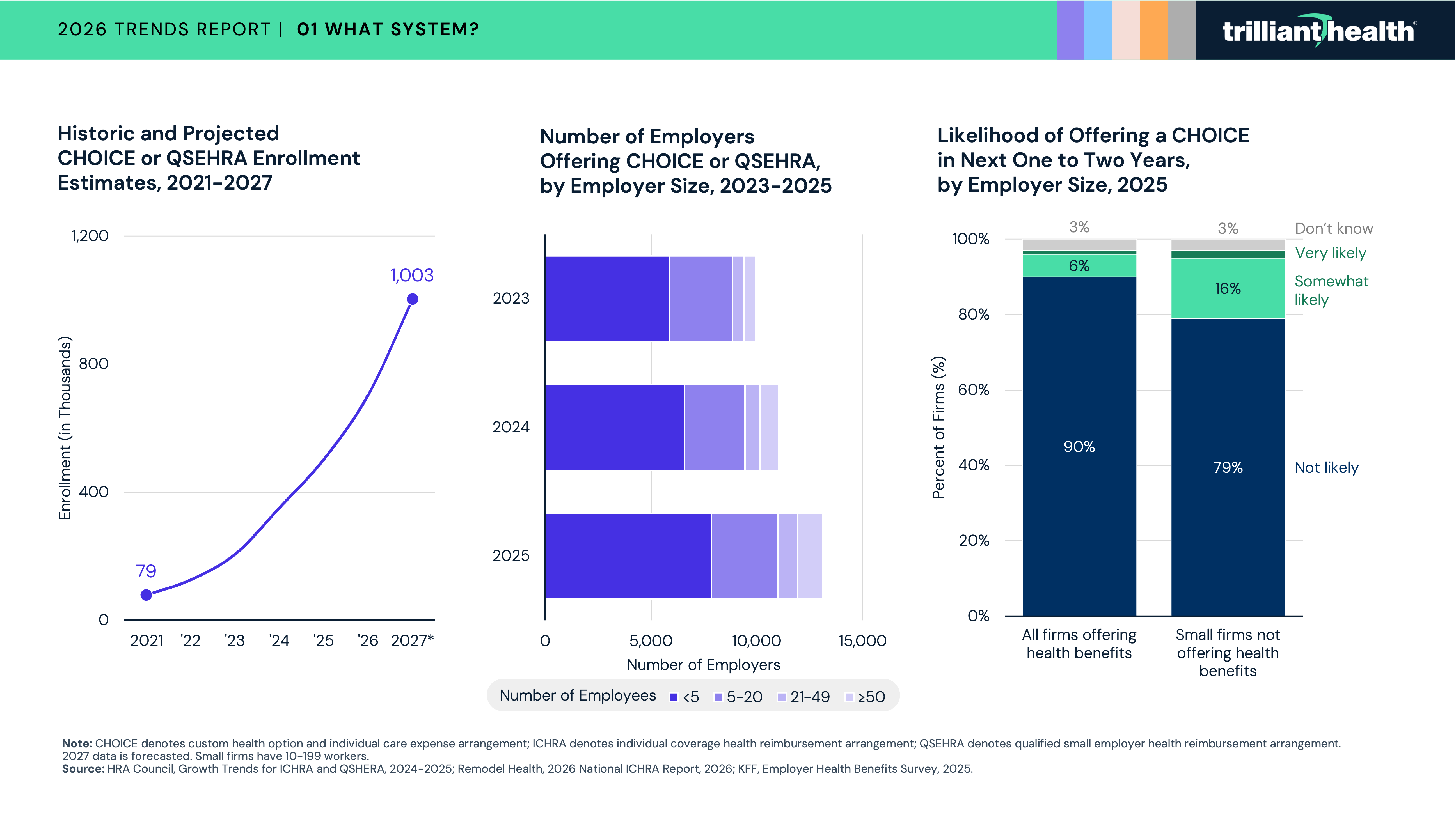
Until now.
On October 16, 2026, Centene issued this press release:
“Centene Corporation, a leading healthcare enterprise committed to helping people live healthier lives, announced the expansion of its CHOICE Arrangements benefit program (formerly ICHRA) to employees in Ohio and Oklahoma for plan year 2027. Building on the successful implementation of the program for Indiana-based employees in 2026, the expansion reflects Centene's ongoing commitment to providing employees with greater flexibility and choice in their health coverage.
‘At Centene, we believe healthcare coverage should be as unique as the people it serves,’ said Chief Executive Officer, Sarah M. London. ‘Our experience in Indiana has demonstrated the value of empowering employees with greater flexibility and choice in their healthcare decisions. Expanding CHOICE Arrangements to our Ohio and Oklahoma employees reflects our confidence in this model and our commitment to leading the evolution of affordable employer-sponsored healthcare.’
Since launching the program for Indiana-based employees in 2026, Centene has gained valuable insights into how personalized health coverage solutions can better meet the diverse needs of its workforce. The expansion represents another milestone in the company's broader strategy to drive innovation in healthcare benefits and support the growing adoption of CHOICE Arrangements nationwide.
‘As CHOICE Arrangements continue gaining momentum across the country, we are proud to put this innovation into practice within our own organization and demonstrate how it can deliver meaningful value for employees,’ said Alan Silver, President of Ambetter Health Solutions.”
In other words, a Fortune 20 health insurance company just signaled that it doesn’t want to be in the business of administering healthcare benefits for its employees.
The more that employers offer CHOICE Arrangements, the more that employers will shift the risk for healthcare spending to employees, to whom the rest of the economy refers as consumers. The history of the American consumer suggests that individuals accessing healthcare benefits through CHOICE Arrangements will ultimately assert their agency to make healthcare decisions based on their individual definition of value.
Yesterday, America voted, and this is what Americans were thinking about in the voting booth:
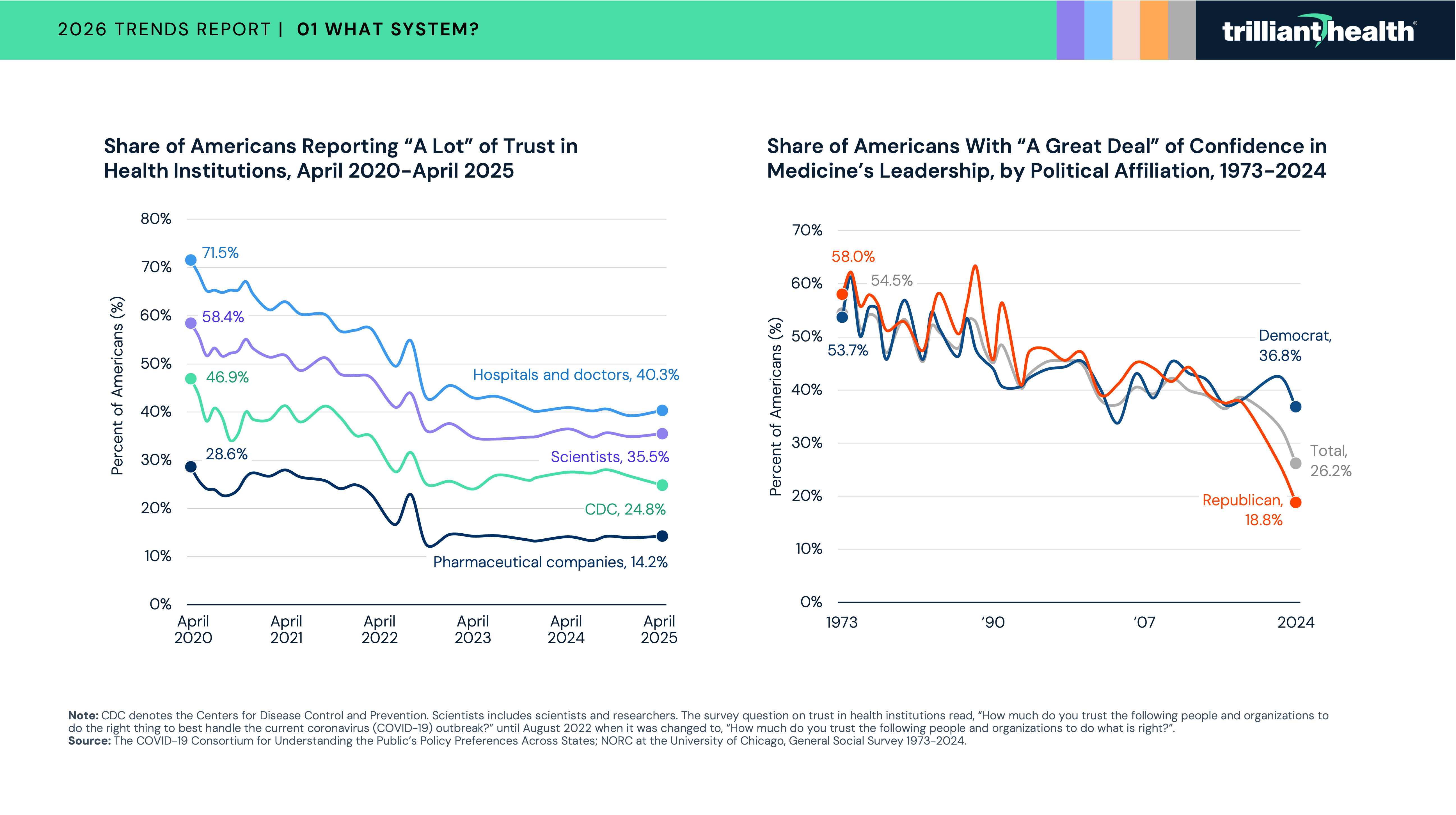
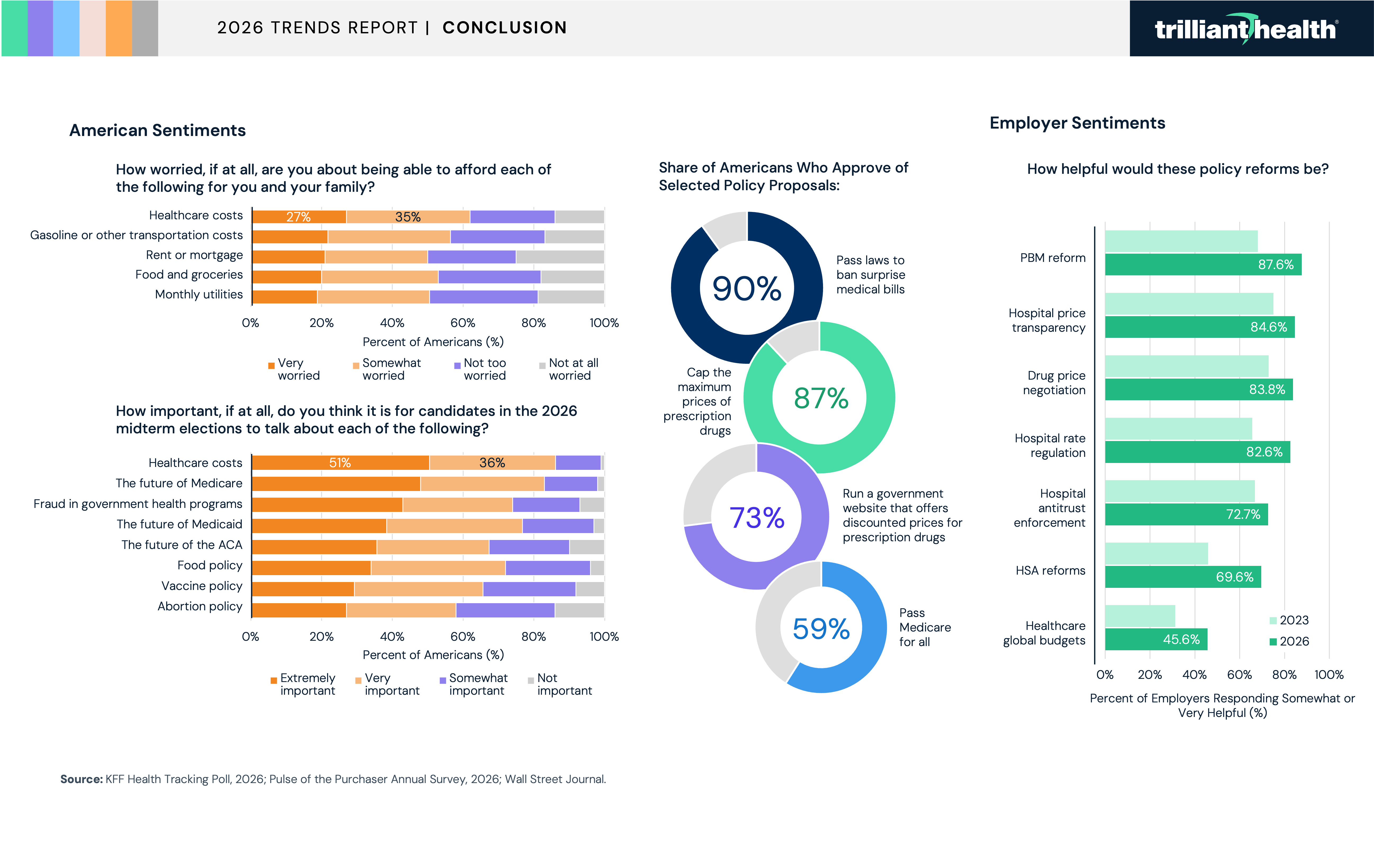
They don’t trust you, and they don’t want what you are selling, and they cannot afford it anyway. They want the Federal government to impose price caps.
Value for money is the organizing principle of Adam Smith’s “invisible hand,” and it drives every truly consumer-centric decision in the U.S. economy. There is nothing the American consumer loves more than a good deal, even if only some of them love “price shopping.”
The more price caps are implemented, the more that American consumers will measure value based on “quality, efficiency, effectiveness, outcomes, process, experience and on-going perception.” Even so, keen observers of England’s National Health Service know that there is a “shadow” health economy where a select number of providers thrive outside of government price caps because of the value they deliver.
Your organization will soon be forced to choose between two divergent roads: one governed by delivering value for money, and the other governed by price caps. The former requires a radical transformation of everything about your business, something that Eli Lilly seems to have discovered before the rest of the industry; the latter requires nothing except your continued devotion to the status quo.
Of course, the status quo is septic, and no industry is more afflicted than the health economy. The status quo is also antithetical to first principles thinking, and no industry consistently demonstrates less first principles thinking than the health economy.
If you decide to take the “road less traveled” of delivering value for money, first principles thinking insists that you face the reality that your customers don’t trust you and don’t want what you are selling and cannot afford it anyway. The good news for your organization is that “rock bottom is good solid ground,” as Wynonna sings, so start building a business on the foundation of delivering value for money.
If you decide to stay on the status quo superhighway, remember the words of General Eric Shinseki: “If you don’t like change, you’ll like irrelevance even less.”