Product Blog
Meet Oria: Highlights From Our Client Webinar
November 10, 2026On November 5, 2026, Trilliant Health hosted a client webinar introducing Oria, our AI strategist. The webinar included a live demonstration across three use cases: surgical referral alignment, downstream specialty leakage and emergency department utilization.
Why We Built Oria
Healthcare is a negative-sum game. The U.S. spent $5.3T on it in 2024, one of every $21 spent on the planet, and gets below-average performance for the money.
Hal Andrews, President and Chief Executive Officer of Trilliant Health, framed the pressure in terms of supply, demand and yield. The commercially insured population is shrinking, as roughly 10,000 people a day age into Medicare. Demand for care is largely flat. And price caps are spreading at both the Federal and state levels. Meanwhile, the competition is no longer only the health system across town.
In that environment, the organizations that win are the ones that make better decisions faster. Trilliant Health has spent a decade on the "better." Oria is about the "faster."
How Oria Works
Oria combines three inputs: your conversation with it, a context library distilled from thousands of analyses our Strategic Resources Group (SRG) has performed over the past decade and Trilliant Health's data.
Oria plans before it runs and asks when something is unclear. Then it executes the plan and returns an answer as narrative, charts or data tables. It always shows its work, down to the SQL it ran. As Chief Data Officer Matt O'Neill said, the principle is one we use often at Trilliant Health: trust but verify.
A Quick Tour
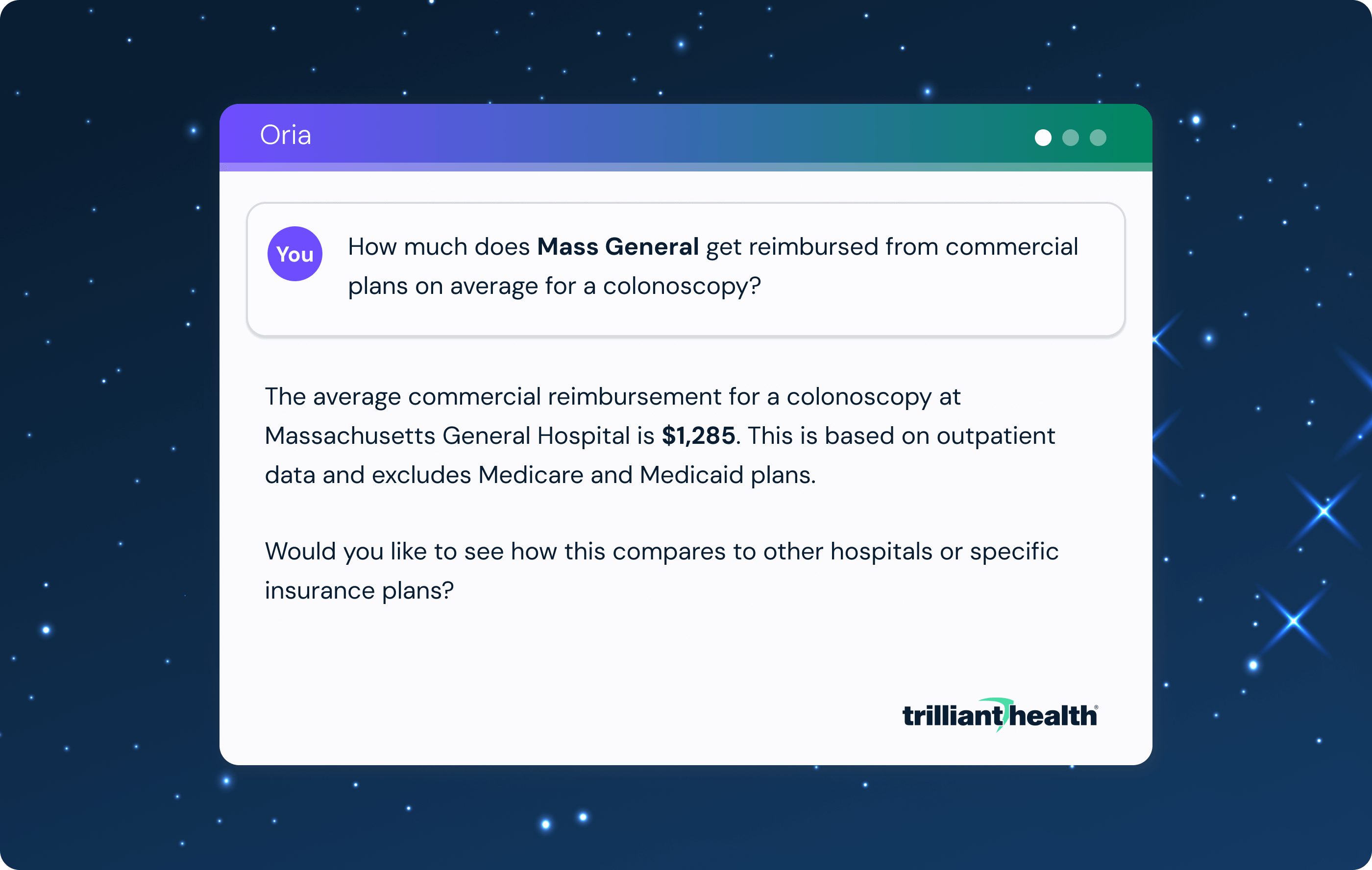
Oria's layout is simple: a chat box in the center and your chat history on the left, so you can return to past conversations.
Chief Customer Officer David Taylor's rule of thumb for working with it is 20/60/20. The first 20%, asking the right question, is yours. Oria does the next 60%: querying, organizing, executing and writing the narrative. The last 20% is shared, as you validate and refine the result together.
Oria can also run several analyses in parallel. In the demo, David ran all three of the use cases below at once.
Three Use Cases
Each of these could be done in our dashboards with a couple of hours of filtering, joining and exporting. Oria returned each in a few minutes.
1. Surgical Referral Alignment
Referral patterns are the one topic nearly every client asks about, so David started there. He asked Oria where the opportunity lies to grow surgical volume across three service lines, sorting every referring provider into one of two groups: highly aligned, meaning one organization captures at least 65% of the provider's referrals, or splitter, meaning none does.
I'm evaluating opportunities to grow surgical services across three service lines: orthopedics, cardiovascular and gastroenterology.

Focus on referrals sent in 2025. Include only referring providers with more than 100 relevant surgical referrals. Use the full complement of visits: closed, mixed and open.

Classify each referring provider based on downstream surgical referrals:
- Highly aligned: one downstream organization captures 65% or more of the provider's referrals.
- Splitter: no single organization captures more than 65% of the provider's referrals.

Give me a total market summary of the addressable opportunity, a referral alignment summary and a comparison across the three service lines.

Also generate a CSV that includes each referring provider's National Provider Identifier (NPI), name, specialty, practice, classification, total 2025 surgical referral volume, volume by service line, the downstream organization the provider refers to most and the share of referrals that organization captures.
Before running anything, Oria restated the plan in its own terms. It mapped "ortho, cardio and gastro" to Trilliant Health's service lines, confirmed the thresholds and classification logic and asked David whether its approach matched his intent.
The answer: about two-thirds of qualifying referring providers were splitters, but the picture varied by service line. Roughly 75% of gastroenterology referrers split their referrals, and orthopedics looked similar, compared with about 30% in cardiovascular, where referring cardiologists are more likely to be employed by a health system and keep patients in network. Oria named gastroenterology and orthopedics as the primary opportunities and tiered the best business development targets. The CSV came back with every field requested, a file that would otherwise take a series of filters and lookups to build.
The 65% threshold is only an example. You define the categories, the cutoffs and the number of tiers in your prompt.
2. Downstream Specialty Leakage
The second analysis followed the patient instead of the referral. When someone enters care through an employed primary care provider, how much of what happens next stays in network? David used Henry Ford Health as the example and limited the question to a defined set of services, because leakage only matters for care a health system offers. He also asked for the findings as a Word document.
Analyze downstream specialty care utilization for patients attributed to the Henry Ford Health employed primary care network for calendar year 2025.

Focus on these core services: inpatient services by service line, imaging, orthopedic surgery, heart and vascular procedures, general surgery, gastroenterology, oncology, surgical oncology, physical therapy and behavioral health.

Then create an executive-level summary as a Word document highlighting the most important facts and findings.
Oria confirmed that 2025 data was complete, matched the listed services to our Visits dataset and explained how it would define leakage. Then it stopped to ask two things it would not assume: how to define the network and which geography to use. David chose the rendering organization and the full Detroit core-based statistical area (CBSA).
What came back was a leakage rate for each service category, the in-network and out-of-network volumes behind it and the organizations capturing the care that left. Oria packaged it all in a Word document, with an executive summary and a strategic insight for each service, ready to edit and circulate.
3. Emergency Department Utilization on Game Days
The last question shows what Oria does when the answer depends on information Trilliant Health does not have in its datasets. David asked whether emergency department visits near Ford Field change when the Detroit Lions play at home.
How does emergency department utilization at facilities near Ford Field change on Sundays when the Detroit Lions have a home game compared with Sundays without a home game?

Compare the 2021 and 2022 seasons. Highlight factors that could have influenced utilization across each season and on individual game days. Exclude Thanksgiving and Monday night games because they are outliers.
Trilliant Health does not keep a dataset of football schedules, so Oria went and found one. It searched the internet for both seasons' home games, located Ford Field and proposed limiting the analysis to emergency departments within five miles, which David confirmed.
The result was a game-by-game comparison against non-game Sundays. Visits were +19% versus an average Sunday for the 2021 home opener, then fell below average as that season went on. In 2022, nearly every home-game Sunday ran above average, including a stretch of +5%, +11%, +19% and +10%.
Meet Oria: Q&A
The questions below are representative of those asked during the session. We’ve grouped similar questions and edited them for clarity. If you have a question that isn’t covered here, reach out to your SRG representative.
Getting Started
Q: Is there a guide to help us write prompts that get the data we need?
A: Yes, and there are several ways to get help today:
- Oria can help you write the prompt. Ask it something like, "Help me build a comprehensive prompt to understand orthopedic market share for a surgery center company." Oria will walk you through what to define, including geography, in-market versus out-of-market framing, the patient cohort and time period.
- Training will focus on prompting. Training on Oria is different from training on Tableau dashboards. Instead of how to apply filters, it focuses on how to ask the right questions. Our SRG team pressure tested Oria over the past year and has built documentation on how to structure questions well.
- Your SRG representative can work alongside your team. If someone on your team is less comfortable writing prompts, we're happy to hold shared working sessions.
- More resources are on the way. We’re developing additional resources, including example prompts, to help your team get the most out of Oria.
Q: A business user may not write a detailed prompt. Can they start with a simple question and let Oria ask follow-ups?
A: Yes. That's how Oria is designed to work. Before running an analysis, Oria lays out its planned approach and asks clarifying questions when something is unclear, such as which geography, date range or facilities to include. It won't move forward on assumptions without confirming them with you.
The person asking still owns the starting point: making sure the question reflects what they actually want to know. From there, Oria handles the querying, organizing and narrative, and the user validates the result and refines it as needed.
Q: Can I go back to a prompt and ask Oria to add to it or change it?
A: Yes. Within a chat, you can ask Oria to expand, narrow or adjust a prior analysis. During the webinar, for example, we asked Oria to rerun the 2025 referral analysis for 2024. It kept the same measures and parameters, changed only the date range, and returned a year-over-year comparison. You can also return to earlier conversations from your chat history and keep building on them.
What Oria Can Answer
Q: What data can Oria access?
A: Our Visits dataset is available in Oria today. More datasets are coming soon, including our provider directory, demand forecast models and price transparency data. We will continue to evaluate additional data sources (e.g., demographic data) over time.
Q: Can I use Oria as a general chat tool, or does everything have to tie to Trilliant data?
A: You can ask Oria anything, but it's tuned to steer toward healthcare strategy questions. It isn't intended to replace a general-purpose AI tool such as ChatGPT or Claude.
Q: Can Oria pull information from the internet or outside sources?
A: Yes. Oria can search the internet, bring relevant information back into the conversation and combine it with Trilliant's data. In the demo, for example, it looked up the Detroit Lions' home game schedules online, then analyzed emergency department visits near Ford Field on those dates.
With access to the internet, Oria can gather the publicly available information and pair it with utilization data for your market. As with any analysis, review its approach and any assumptions it makes.
Q: Can Oria analyze individual practices and providers, including mid-level providers?
A: Yes. Oria can analyze individual practices and providers in our data, including advanced practice providers. In one recent orthopedic surgery analysis, for example, Oria separated the surgeons from the physician assistants who assisted on the procedures and reported them as a distinct insight.
One caveat applies to anyone working with claims data. When care is billed "incident to" a physician, the physician's NPI appears as the rendering provider even if a mid-level provider delivered the care. Oria will flag nuances like this where it can, but it can't fully correct for them.
Q: Do market assessments account for claims Trilliant doesn't capture?
A: No. Like our SRG representatives, Oria can only see the data we have.
How Oria Handles the Data
Q: How does Oria handle different data lags across Medicare, Medicare Advantage and commercial data?
A: Oria understands claims runout. At the start of an analysis, it confirms whether the time period you asked about is complete.
- If the data is complete, Oria notes that there are no runout concerns. For example, it confirmed that all of 2025 is complete.
- If the period has runout, Oria flags it and shows the date the data runs through. For example, it noted on the webinar that 2026 is only partially complete, as of the date of its recording.
When a period is partial, Oria asks how you'd like to handle it before proceeding.
Q: If different people ask the same question for the same time period, will they get the same answer?
A: The underlying data and core findings will be consistent, but the wording won't be identical. Like ChatGPT or Claude, Oria is not deterministic: the same question asked twice can come back phrased or presented a little differently. The data and the main takeaway should stay the same.
Q: Will Oria combine datasets, such as current utilization with demand forecasts?
A: Yes. As new datasets are added, Oria will be able to use all of them in context with each other rather than one table at a time. Once demand forecasts are integrated, for example, you'll be able to ask about current utilization in a ZIP code alongside five-year projected orthopedic demand.
Uploads, Memory and Custom Business Rules
Q: Can I upload files into Oria, such as a list of ZIP codes from Excel or a mapping document for custom groupings?
A: Not yet, but uploads are coming in two stages:
- General uploads are in quality assurance now. You'll be able to attach documents such as a PDF or a short list, and Oria will use that content alongside your question.
- Larger data uploads are next. For larger datasets, such as a long list of NPIs or ZIP codes or a custom mapping table, Oria will store the data as a table and run queries against it directly. That's more accurate and efficient than reading it as text.
There won't be a single preferred format for mapping documents. Once tabular uploads are available, Oria will accept tabular data whether it comes from Excel, CSV or PDF. In the meantime, you can include specific ZIP codes, date ranges and NPIs directly in your prompt.
Q: Will Oria remember context from previous chats, or can we load our own business rules so we don't have to repeat them in every prompt?
A: Not yet, but this is coming, both at the user level (i.e., your own preferences and memory) and at the organization level (i.e., context shared across all of your organization's users).
There are two reasons we're taking the time to get it right:
- Business rules should be treated as data. We want rules that are tabular to be handled as data when Oria runs an analysis, not just read as text.
- We must be careful that it does not degrade the quality of answers. We grade Oria's responses through an extensive evaluation process. Before releasing saved context, we're bringing context into that grading to make sure answers stay just as strong when users have added their own.
Exports
Q: Can I download the data behind Oria's analysis? Is there an export row limit?
A: Yes. Oria can export results as a CSV, as well as other file formats, such as Parquet. It can also generate summary documents in Word, like the executive summary shown in the demo.
For each component of an analysis, you can:
- Drill into the exact query Oria ran.
- Download the summary data behind that step as a CSV.
Currently, downloads are limited to 64MiB, but that will increase over time.
Models, Privacy and Pricing
Q: What AI model does Oria use?
A: Oria uses a number of different models, all run on a zero data retention inference service. That means model providers don't keep your data or use it in their own datasets.
We choose models based on performance for a specific use case. For example, the model best suited to market planning may differ from the one best suited to price transparency questions. We'll continue to adjust as models improve, so we don't tie Oria to a single provider.
Q: Can other clients see our questions?
A: No. Each client tenant is federated, and all information is kept confidential. Your contract's confidentiality provisions apply to Oria exactly as they do to your work with your SRG representative.
Q: Is Oria "trained" on our chats?
A: Oria learns from each chat, keeping a "memory" that helps focus its answers. In some instances, and in an anonymized fashion, it also distills general knowledge and promotes it to our global context library. Your organization's specific questions and analyses are never shared with other clients.
Q: Does Oria need access to our systems?
A: No. Oria doesn't need to access your data or systems. Instead, you're accessing our data and our systems.
Q: Does Oria use tokens, or does membership include unlimited queries?
A: Oria uses tokens. We're still learning exactly how far a given amount of credits goes. Based on our SRG team's usage over the past year, though, we expect most clients won't run into limits. Our goal is for you to run as many queries as your strategy requires.