Study Takeaways
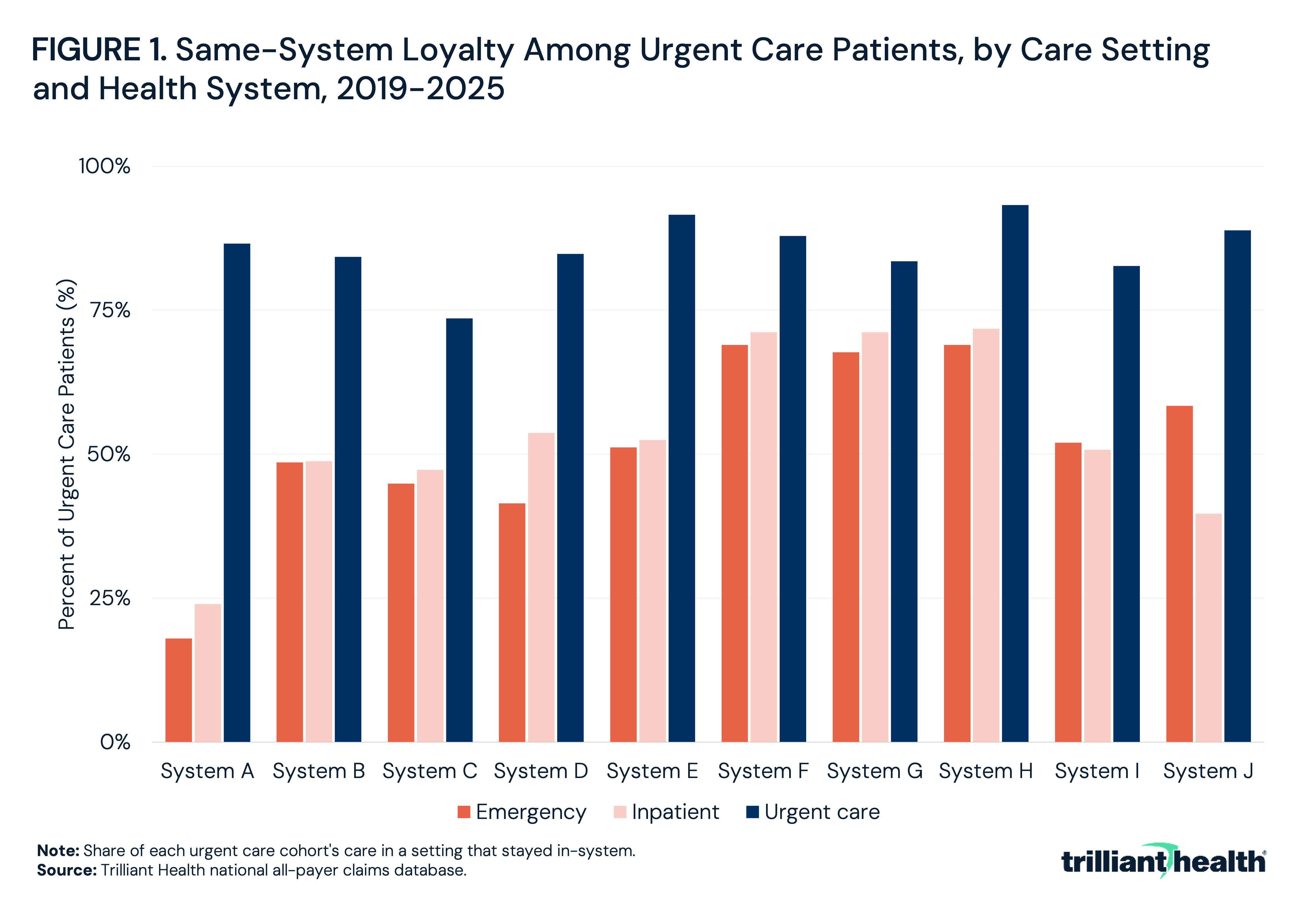
- Patient loyalty to a single health system's urgent care ranged from 73.6% to 93.3%.
- The extent to which urgent care utilization was associated with same-system loyalty for downstream care was variable, ranging from 18.0% to 69.0% for emergency care and 24.0% to 71.8% for inpatient care.
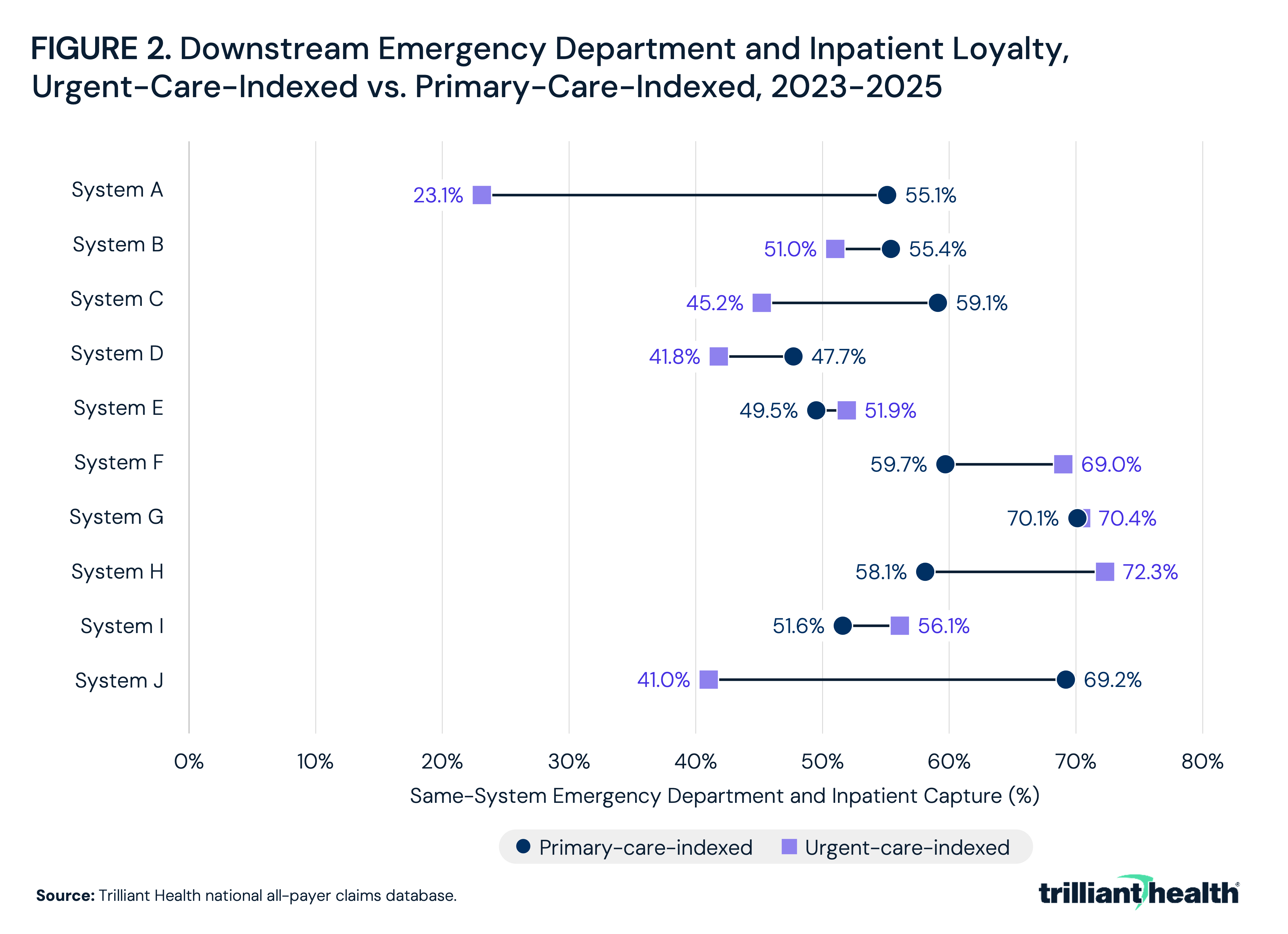
- Of the 10 health systems examined, five had higher primary-care-indexed loyalty, three had higher urgent-care-indexed loyalty and two had similar loyalty using either approach. Primary-care-indexed loyalty ranged from 47.7% to 70.1%, while urgent-care-indexed loyalty ranged from 23.1% to 72.3%.
Over the past decade, health systems have expanded urgent care capacity expecting that patients who use a system's urgent care clinic will utilize their system for downstream higher-acuity care. That expectation underlies the treatment of urgent care as a loss leader, in which a health system accepts narrow, or even negative, margins on low-acuity visits to gain more profitable emergency, inpatient and specialty care. A recent companion analysis found that urgent care utilization has returned to pre-pandemic levels and that patients are highly loyal to a single urgent care brand and location.1 This analysis measures downstream loyalty across a panel of 10 geographically diverse health systems to examine how much of an urgent care patient's subsequent care remains “in-system.”
Background
Consumer-focused businesses often provide a service or good for which they accept low to negative operating margins (i.e., “loss leaders”), to entice consumers to purchase other higher-margin services or goods from that business. In the retail sector, Costco’s $1.50 hot dog combo is a well-known loss leader.
Many health systems offer primary care services as a loss leader, whether by employing primary care physicians or operating urgent care clinics, with the goal of establishing a relationship with consumers. Even though few health systems can operate primary care services profitably, health system executives believe that primary care functions as an entry point for referrals to profitable specialty and ancillary services. Many health systems continue to expand their primary care service offerings by opening or acquiring urgent care clinics to offer same-day access that traditional primary care does not offer.
By 2025, approximately two in five urgent care clinics were affiliated with a hospital or health system, and approximately one in five were owned by a private equity (PE) firm.2,3 For a PE firm, return on investment is measured at the clinic itself and realized at exit, frequently to a health system. In contrast, the return on investment in urgent care clinics for health systems is measured by the volume of “in-system” downstream referrals for higher-acuity care, not the profitability of the individual clinic.
Our previous analysis documented that urgent care users demonstrate a high degree of loyalty to urgent care brands, and even to a specific location. However, irrespective of a patient’s loyalty to an urgent care location for low-acuity needs, every patient must seek higher-acuity care (e.g., imaging, inpatient, specialty) somewhere other than an urgent care clinic. This analysis assesses the loss leader hypothesis, connecting an urgent care visit to subsequent care to measure the extent to which loyalty observed for low-acuity care corresponds to retention of future higher-acuity services.
Analytic Approach
The Trilliant Health Provider Directory and national all-payer claims database were used to identify a panel of 10 geographically diverse health systems that operate and own urgent care clinics and to measure patient loyalty across settings – urgent care, primary care, emergency department (ED) care and inpatient care – between 2019 and 2025. The health systems range from national multi-state systems to single-metropolitan systems. All system-operated urgent care clinics were included in the analysis, regardless of proximity to an affiliated hospital. The health system names are anonymized as System A through System J. The analysis was restricted to continuously enrolled patients. Visits with a COVID-19-specific diagnosis were excluded from the analysis.
First, urgent care loyalty was calculated, defined as the share of urgent care visits that occurred at each of the 10 systems rather than at other providers. Next, we examined downstream loyalty for ED visits and inpatient stays. More specifically, for patients with at least one visit to an urgent care clinic owned by one of the 10 health systems, ED loyalty was calculated as that cohort's ED visits at the applicable health system divided by the total number of ED visits by the cohort. This same logic was then applied to inpatient care.
Finally, to compare the relative effect of urgent care and primary care on downstream loyalty, patients were indexed separately on their first urgent care visit and their first primary care visit between 2023 and 2024, and same-system ED and inpatient loyalty was measured over the 12 months following either index visit.
Findings
Across the 10 health systems examined, urgent care loyalty was high, while loyalty from those same patients was lower across other care settings and varied widely across systems. Urgent care loyalty averaged 85.7%, ranging from 73.6% (System C) to 93.3% (System H) (Figure 1). Among urgent care patients, ED loyalty was lower, averaging 52.0% and ranging from 18.0% (System A) to 69.0% (Systems F, H). For those same patients, inpatient loyalty averaged 53.1%, ranging from 24.0% (System A) to 71.8% (System H).
To compare urgent care with primary care as an indicator of downstream loyalty, patients were indexed separately on their first urgent care visit and their first primary care visit, and same-system ED and inpatient loyalty was measured over the following 12 months. The results were highly variable. Across health systems, urgent-care-indexed loyalty had a wider distribution ranging from 23.1% to 72.3%, while primary-care-indexed loyalty ranged from 47.7% to 70.1% (Figure 2). Primary care was associated with higher downstream loyalty than urgent care for five systems, while urgent care was associated with higher downstream loyalty for three systems. For example, at System A, primary-care-indexed loyalty (55.1%) was more than double urgent-care-indexed loyalty (23.1%). In contrast, urgent-care-indexed loyalty (72.3%) was 14.2 percentage points higher than primary-care-indexed loyalty (58.1%) at System H. The remaining two systems, Systems E and G, had nearly even downstream loyalty when indexed on primary care or urgent care, diverging by less than 2.5 percentage points.
Conclusion
This analysis demonstrates that although patients were consistently loyal to urgent care brands, same-system loyalty for ED and inpatient care varied widely. Notably, whether urgent care or primary care was a better “loss leader” also varied, with only one system achieving similarly high loyalty from urgent-care-indexed and primary-care-indexed visits (System G), and urgent care showing more variability overall.
These findings invite many questions for health system operators and strategists. For example, System A, which had the widest disparity between urgent-care-indexed and primary-care-indexed loyalty and the lowest same-system ED and inpatient loyalty, has a joint venture partner for urgent care, suggesting operational differences between its urgent care clinics and primary care practices. In contrast, System H’s lower primary-care-indexed loyalty might suggest that its urgent care sites were more convenient than its primary care sites or indicate challenges in making “in-system” referrals. At a minimum, the disparate results for these 10 systems are a reminder of the axiom that healthcare is local.
Our previous analysis questioned the continued expansion of urgent care clinics by PE firms and health systems based on flat utilization trends. This analysis reveals longstanding assumptions that urgent care loyalty will manifest in “in-system” utilization of more profitable, higher-acuity services are ill-founded. Taken together, these analyses suggest that health systems considering additional investment in urgent care capacity should first analyze whether it is merited by current and projected demand. In markets with increasing demand, health system executives should understand downstream “in-system” referral patterns to assess whether their investment in additional urgent care clinic capacity will benefit them or their competitors.
Get the latest insights delivered to your inbox.
Was this shared with you?
Subscribe for weekly insights.
Subscribe to receive weekly insights from Trilliant Health's Research Team
Interested in citing our research? Please follow this guide.