Develop Service Line Strategies

Analyze the Competitive Landscape

Anticipate Future Patient Needs

Identify Sites To Capture Demand

Drive Loyalty Across the Patient Journey

Leverage Price Transparency Insights

Retain Patients in Your Network

Match Provider Supply to Demand

Acquire Commercial Patients

Capture Outpatient Demand

Target High-Value HCPs

Strengthen Provider Networks
We collect and organize the industry’s most comprehensive healthcare datasets.
See demand, supply and yield across the U.S. health economy

Validated Data for 2.9M Practitioners

Episodes of Care for 300M Patients

Negotiated Rates for Any Service at Any Location
Flexible solutions to fit your specific needs and workflow
Free resources to help health economy stakeholders use our products and data

Answer Key Questions in Seconds
AI Chatbot for Hospital Prices

Custom Enterprise-Level Analyses

Data-Driven Benchmarking Tool

Inform Data-Driven Strategies

Health Economy Survival Strategies

Product Guides and Feature Releases

Strategic guidance and commentary from our CEO, Hal Andrews
.png)
Analysis of trends shaping the health economy

Original research on trends shaping the health economy

Develop Service Line Strategies

Analyze the Competitive Landscape

Anticipate Future Patient Needs

Identify Sites To Capture Demand

Drive Loyalty Across the Patient Journey

Leverage Price Transparency Insights

Retain Patients in Your Network

Match Provider Supply to Demand

Acquire Commercial Patients

Capture Outpatient Demand

Target High-Value HCPs

Strengthen Provider Networks
We collect and organize the industry’s most comprehensive healthcare datasets.
See demand, supply and yield across the U.S. health economy

Validated Data for 2.9M Practitioners

Episodes of Care for 300M Patients

Negotiated Rates for Any Service at Any Location
Flexible solutions to fit your specific needs and workflow
Answer Key Questions in Seconds
Custom Enterprise-Level Analyses
Inform Data-Driven Strategies
Free resources to help health economy stakeholders use our products and data
AI Chatbot for Hospital Prices
Data-Driven Benchmarking Tool
Health Economy Survival Strategies
Product Guides and Feature Releases

Strategic guidance and commentary from our CEO, Hal Andrews
.png?width=171&height=239&name=2025%20Trends%20Report%20Nav%20(1).png)
Analysis of trends shaping the health economy

Original research on trends shaping the health economy
As posed most recently, health system executives must ask themselves “is our goal to be in the hospital business, or rather to be in the healthcare delivery business?”
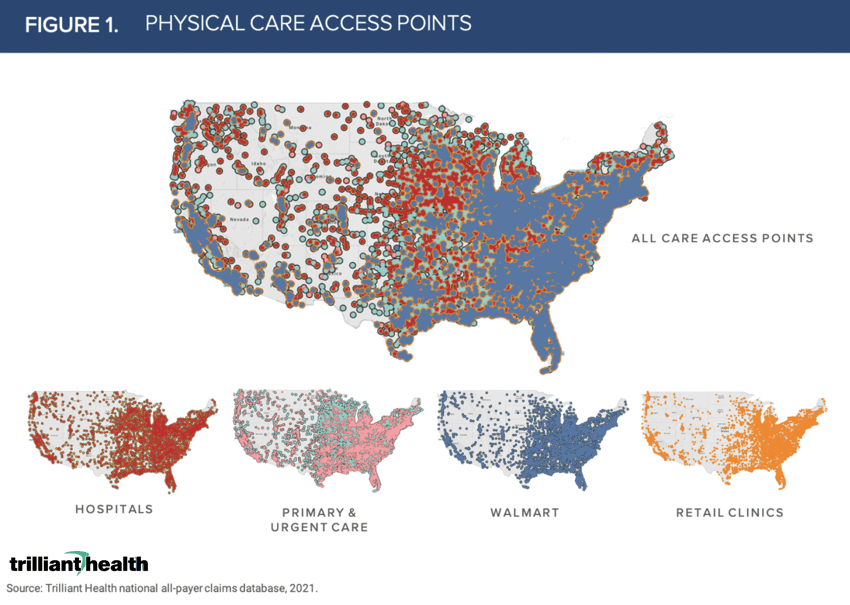
As more entrants stack the supply-side of the health economy equation (Figure 1), it becomes even clearer that the “winners” in the post-pandemic health economy will be those that not only embrace a care delivery mindset but, more importantly, execute targeted strategies that reflect it.
As previously written, average consumer loyalty to any given provider network is only 60% and is declining as supply increases. While a few providers have developed integration strategies to maintain, and in a handful of cases increase, consumer loyalty, the growing number of care options will continue to challenge health systems’ traditional strategies.
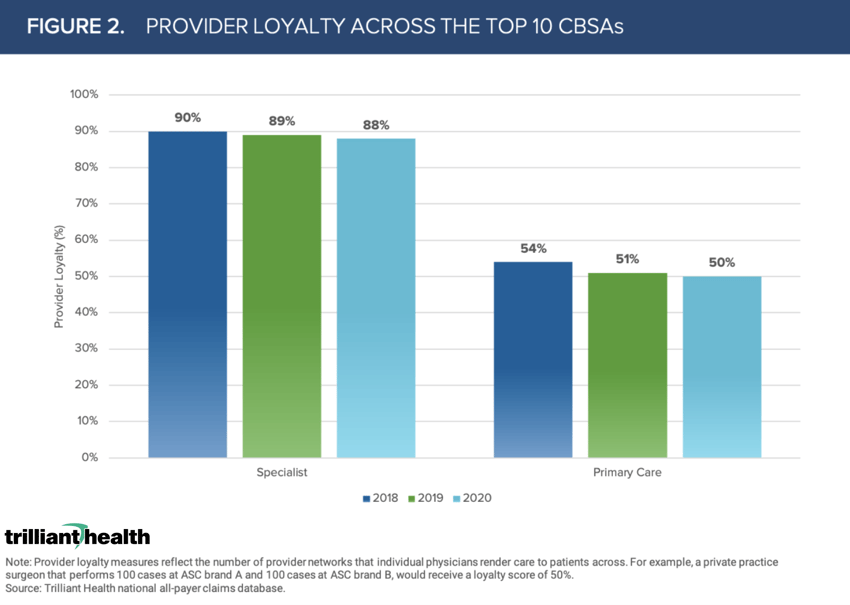
We define provider loyalty as a measure of the number of provider networks (or brands) that individual physicians render care across for patients. Not only are PCPs not very loyal; specialists are more loyal than primary care (Figure 2). The three-year average loyalty for specialists is 89% compared to 51.6% for PCPs. Moreover, specialist and primary care loyalty has declined from 2018 to 2020 in tandem with the growing supply of provider networks, which is consistent with consumer loyalty trends.
Health systems’ historic focus on the physician as the customer has persisted for decades because consumers have not objected to being treated as “patients” by hospitals and physicians. In fact, patients have faithfully followed doctors’ orders, particularly with respect to referrals for services. As a result, healthcare providers have not been required to market or sell their services to the end users of those services to increase market share.
Several recent developments call that strategy into question, including the rapid expansion of new service providers, the increasing number of employed physicians, and the fact that the largest employer of physicians is Optum, which is owned by the nation’s largest insurer. With hospital providers in the minority of suppliers, understanding the factors that impact consumer and provider loyalty is a critical dimension of developing effective strategies for maintaining a competitive advantage in the healthcare delivery business.