Studies Archive
October 19, 2022
As part of our ongoing Trends Shaping the Health Economy Research Series, we are pleased to release the 2022 Trends Shaping the Health Economy Annual Report.
As a health economist, I study healthcare through the lens of demand, supply, and yield. Even though markets for healthcare products and services deviate from what we economists would call the ideal market, the core principles offer a valuable framework for examining secular trends.
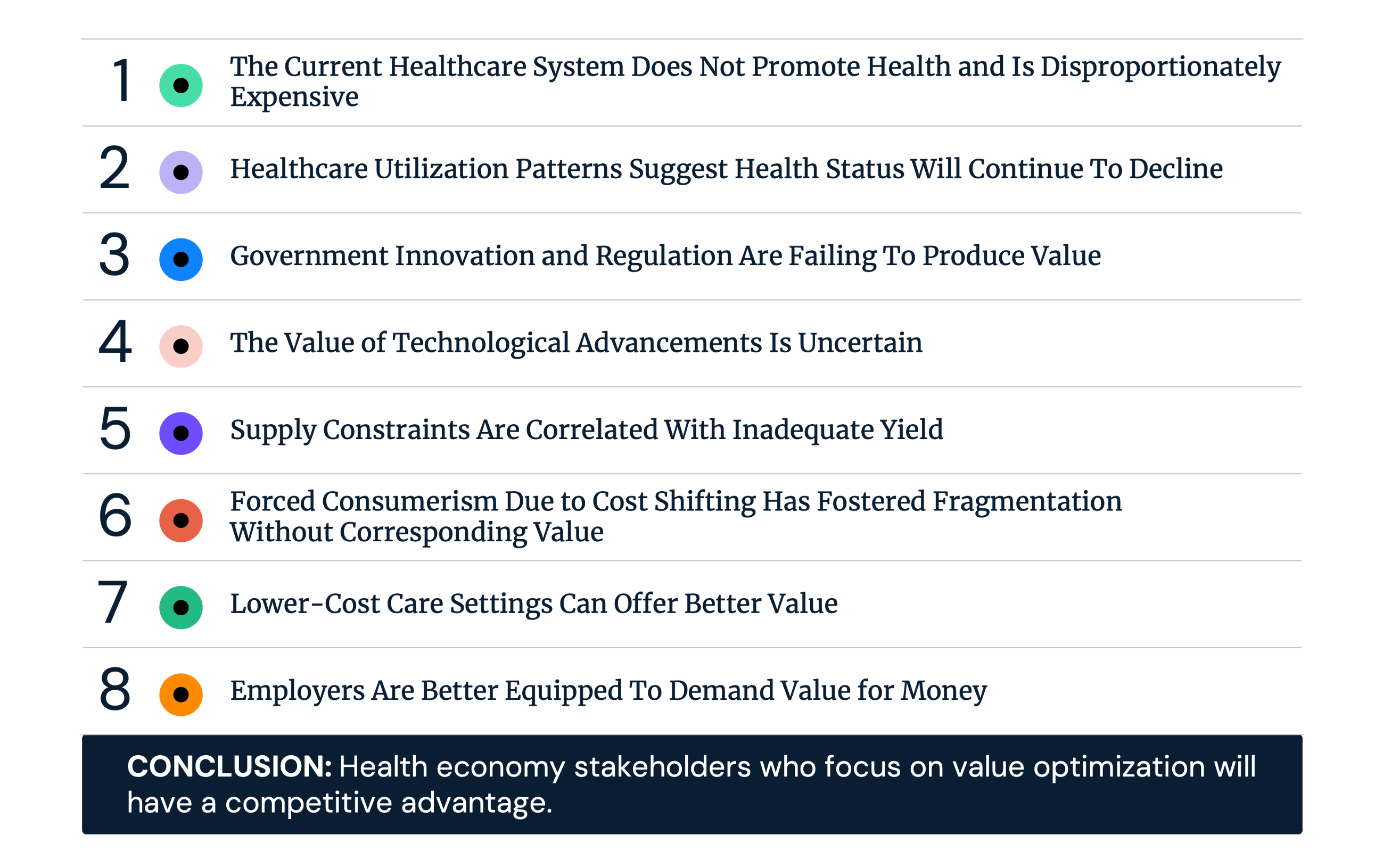
The 2022 Trends Shaping the Health Economy Annual Report provides data-driven insight into 13 secular trends that the COVID-19 pandemic has significantly amplified or accelerated. These trends are relevant to every stakeholder and understanding them has never been more important:
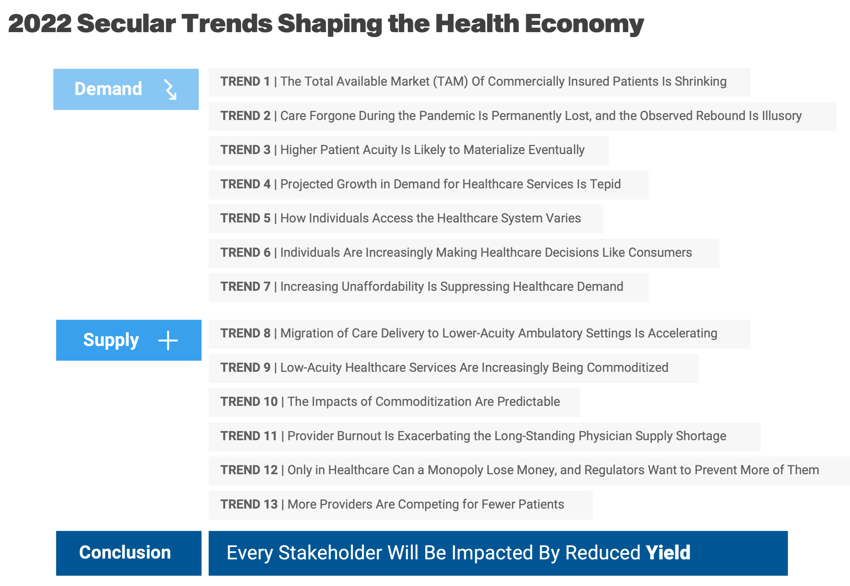
To contextualize these trends, we present a range of demand- and supply-related data points. Demand refers to both the exogenous and endogenous factors that influence consumer preferences (e.g., location) and need (e.g., genetic predisposition) for services; whereas supply refers to all the providers of health services ranging from hospitals and physician practices to retail pharmacies, new entrants (e.g., Amazon) and virtual care platforms.
The intersection of demand and supply informs the expected yield in terms of patients and, therefore, revenue. The cumulative impact of the 13 secular trends: every stakeholder from health systems to medical device companies will be impacted by reduced yield.
Whether the industry is prepared for the dire consequences of reduced yield is an open question. Amid the accelerating forces catalyzed by the pandemic, I encourage you to read this report (a few times), in order. Supporting each secular trend are a handful of data stories grounded in facts about the past along with projections about the future based upon sophisticated machine learning models, with minimal reliance on survey data.
Armed with this research, I encourage you to think critically about what each trend means for your organization’s future. While this study is not intended to provide all the answers, I hope that you will use it as a tool to ask the right questions.
- What trends have you not considered, and how will they impact the markets that your business serves?
- How well prepared are you as compared to your current competitors?
- Are you prepared to compete against new entrants? How can understanding these trends improve your organization’s capital allocation strategies?
- How can you compete in an era of declining yield?